
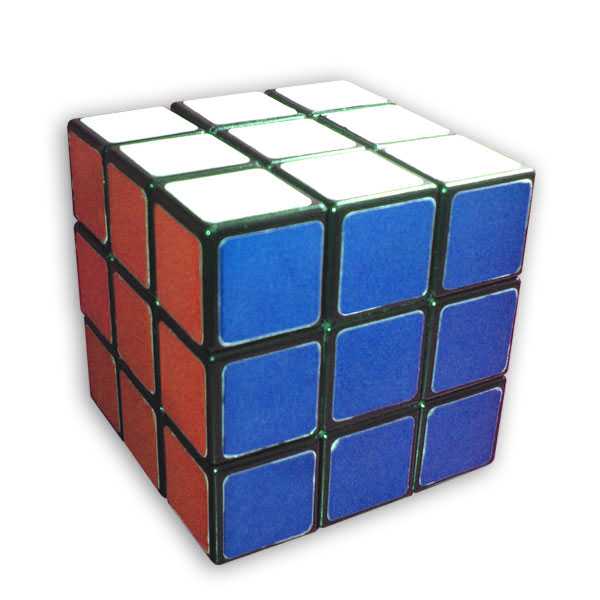
The Rubik’s Cube: How a Hungarian Puzzle Ate the 80s
Every 80s kid has the same memory: the satisfying clack of a fresh cube, the pride of solving one side, and the slow horror of realizing that solving one side had wrecked the other five. Then, the peeling. Come on. You peeled the stickers. Everybody peeled the stickers.
The Rubik’s Cube was invented in 1974 by Hungarian professor Ernő Rubik, hit the Western market in 1980, and by 1981 had sold in the hundreds of millions, making it the best-selling toy in history. It wasn’t just a toy. For a few blinding years, a six-sided plastic puzzle was a genuine cultural obsession, and it belonged to the 80s the way big hair and synthesizers did.
From “Magic Cube” to worldwide fever
Rubik built the thing as a teaching tool, a way to explain three-dimensional geometry to his students. He originally called it the Magic Cube (Bűvös kocka in Hungarian), and it took years to escape Hungary. When Ideal Toy Corp licensed it and renamed it the Rubik’s Cube for a 1980 Western launch, it detonated.
By 1981 it was everywhere. It won Germany’s prestigious Game of the Year award. Sales hit the hundreds of millions. And the number that made it legendary: a standard cube has 43 quintillion possible arrangements, 43,000,000,000,000,000,000, and exactly one of them is solved. That’s not a toy. That’s a tiny mechanical villain that fit in your backpack.
The craze that turned into a subculture
Here’s what separates the Rubik’s Cube from a passing fad: it grew its own world. The first World Championship was held in Rubik’s home city of Budapest in 1982, where the fastest solvers on Earth raced the clock. “Speedcubing” was born right there, and it never actually died.
The cube leaked into everything. It showed up in movies and commercials. There were how-to-solve books that sat on bestseller lists. There were spin-off puzzles. And, the deepest 80s flex of all, there was a Saturday morning cartoon, Rubik, the Amazing Cube, in which a sentient, flying Rubik’s Cube had adventures with a group of kids. If your toy got its own cartoon, you had truly arrived in the 1980s.
Remember when the cool kid in class could solve it in under a minute and the rest of us quietly bought the little instruction booklet, or, let’s be honest, twisted it apart and popped the pieces back in the “right” order? Both are valid. Both are 80s.
Why it never really left
Most 80s crazes burned white-hot and vanished. The Rubik’s Cube did something rarer. It faded from fad and settled into permanent. It’s still sold, still solved, still raced. Speedcubers now finish in a handful of seconds. But for anyone who was there, the cube isn’t a competition. It’s a color-block time machine back to a bedroom floor, a tangle of frustration, and a suspicious little pile of peeled stickers.
From fad to permanent fixture
What separates the Rubik’s Cube from the countless toys that flared up and vanished in the 80s is that it never actually went away. The speedcubing subculture born at that first 1982 Budapest championship only grew, with dedicated competitors chipping the solve time down from minutes to a handful of seconds using advanced algorithms and specialized, lightning-fast cubes. Today there’s a global competitive circuit, world records that fall regularly, and an endless supply of tutorials teaching anyone willing to learn. The cube also became a design icon, its six-color grid instantly recognizable, endlessly referenced in art, advertising, and pop culture as visual shorthand for cleverness and puzzles. Most 80s crazes are memories. The Rubik’s Cube is still sitting on shelves, still frustrating new generations, still being solved.
The honest bottom line
The honest statistics: almost nobody solved it. The nation peeled stickers, pried corners apart with butter knives, or quietly put the thing in a drawer, and within a few years the fad had crashed so hard that stores could not give cubes away. The comeback came decades later, through kids on the internet solving in seconds what beat us for years. The cube did not need our generation to conquer it. It just needed to wait us out.
FAQ
Who invented the Rubik’s Cube?
Hungarian professor Ernő Rubik invented it in 1974 as a tool for teaching three-dimensional geometry. He first called it the “Magic Cube.”
When did the Rubik’s Cube become popular?
It launched in the Western market in 1980 and became a massive craze through 1981–82, selling in the hundreds of millions and becoming the best-selling toy in history.
How many combinations does a Rubik’s Cube have?
About 43 quintillion (43,000,000,000,000,000,000) possible arrangements, only one of which is the solved state.
Was there really a Rubik’s Cube cartoon?
Yes: Rubik, the Amazing Cube was a 1980s Saturday morning cartoon featuring a flying, talking Rubik’s Cube.
Is the Rubik’s Cube still around?
Very much so. It never disappeared like most 80s fads. It’s still sold worldwide, and competitive “speedcubing” has solvers finishing in seconds.
We owned the decade this cube owned, the receipts are here. The cube was one obsession in a decade full of them, dig into more in our 80s pop culture icons guide, or revisit the toy aisle with the Cabbage Patch Kids craze next, or see the cube ranked among the decade’s other icons in our 80s symbols guide.