
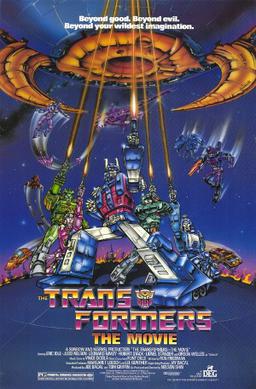
The Transformers: The Movie at 40: Why Optimus Prime Had to Die
Forty years ago today, a toy company killed off its own most beloved character on purpose, in a movie it paid for, in front of the kids who already owned him.
The Transformers: The Movie opened in American theaters on August 8, 1986, which makes today its 40th anniversary. You know the part everybody knows: Optimus Prime dies, about twenty minutes in, and a generation of kids sat there in the dark not believing what they had just watched. Here is the part that usually gets left out. That death was not a story decision that got out of hand. It was an inventory decision, ordered from the top, and the men who carried it out have spent forty years explaining themselves. This September, Hasbro is putting the film back in theaters under a campaign it is officially calling the Apology Tour.
What else was playing the weekend The Transformers opened
Box Office Mojo still has the chart for the domestic weekend of August 8 to 10, 1986, and it is worth looking at before anyone says the word flop.
Number one was Aliens in its fourth weekend, $5,779,352, already past $47 million. Number two, The Karate Kid Part II in weekend eight. Number three, Friday the 13th Part VI: Jason Lives, because in 1986 Jason Voorhees was a going concern. Number five, Top Gun, in its thirteenth weekend, still taking $3,428,696 and past $113 million, because in 1986 Top Gun would not leave. Number eight, Howard the Duck, down 46.4 percent in weekend two and falling.
The Transformers: The Movie opened at number 14, in 990 theaters, with $1,779,559 and a per-theater average of $1,797. It opened behind a six-week-old About Last Night. It finished its domestic run at $5,849,647, against a budget that Wikipedia’s production entry puts at $6 million, sourced to SFX Magazine and a 1987 Los Angeles Times report. The Hollywood Reporter, covering the 40th anniversary re-release this year, puts it plainly: “When it was first released in 1986, The Transformers: The Movie was a box office bomb.”
That was the summer of 1986, and it was a brutal room to walk into. Bobby had been on the air at the Dance Party USA studio since 1985 and Jason came on as a regular in 1986, so that August we were in the studio taping every week while all of this was on the marquee. You could not get away from Transformers that year even if you wanted to. The toy aisle was wall to wall Autobots, the cartoon was on every afternoon, and Hasbro was about to do something to the toy aisle that nobody in the audience saw coming.
Why did Optimus Prime die?
Because Hasbro needed the shelf space.
That is not a cynical reading. It is what the people who made the film say happened. The Transformers television series started in 1984 to sell the toys, and nobody ever died on it. The movie was built as a commercial tie-in for the 1986 toy line, and Hasbro ordered that it kill off existing characters to clear room for the new ones.
Den of Geek laid out the arithmetic in 2019: “Prime, Ratchet, Prowl, and their compatriots were all part of the original 1984 Generation One line, and Hasbro wanted to replace them with shiny new toys like Kup, Blurr, and Rodimus Prime.” Every robot who dies on screen is a product being discontinued. Every robot who shows up new is a product going on sale.
Ron Friedman, who wrote the screenplay after writing for the series, told Hasbro not to do it. From a 2013 interview quoted by Den of Geek: “To remove Optimus Prime, to physically remove Daddy from the family, that wasn’t going to work. I told Hasbro and their lieutenants they would have to bring him back but they said no and had ‘great things planned.’ In other words they were going to create new, more expensive toys.”
Story consultant Flint Dille has been even blunter about how little anyone saw it coming. “We didn’t know that he was an icon,” he said. “It was a toy show. We just thought we were killing off the old product line to replace it with new products.”
Then the movie opened, and they found out. “Kids were crying in the theatres,” Dille recalls. “We heard about people leaving the movie. We were getting a lot of nasty notes about it. There was some kid who locked himself in his bedroom for two weeks.”
The backlash worked. Optimus Prime was brought back from the dead in the television series in early 1987, within months of a toy company having him killed to move product.
The version of this movie that would have been worse
It was scripted meaner than what shipped.
A sequence in which the new Autobot leader Ultra Magnus is drawn and quartered was written and storyboarded, then swapped for a scene where he is simply shot. And there was another one, cut before it was ever produced, that would have taken out almost the entire original cast in a single charge.
Dille described that one to Den of Geek: “[The scene] basically wiped out the entire 84 product line in one massive ‘charge of the light brigade'”. His own summary of what would have followed is the best sentence anybody has written about this movie: “But if you think kids were locking themselves in the bedroom over Optimus Prime, basically in that scene they would’ve seen their entire toy collection wiped out.”
Read that again. The reason the scene is described in terms of a toy collection rather than a body count is that, on the production side, those were the same thing.
Orson Welles made this his last movie
This is the fact that stops people cold, and it is true.
The Transformers: The Movie was the final film featuring Orson Welles. Per the chronology appended to Peter Bogdanovich’s book This Is Orson Welles, cited by Slate, Welles spent October 5, 1985 recording the voice of Unicron, the planet that eats planets. He died on October 10, five days later. The man’s first feature was Citizen Kane. His last was a cartoon based on a line of transforming robots.
He was not precious about it. Film historian Joseph McBride quotes Welles on the job: “I play a planet. I menace somebody called Something-or-other. Then I’m destroyed.”
What you actually hear in the finished film is not entirely him, either. Slate reported that Welles’ voice “was apparently so weak by the time he made his recording that technicians needed to run it through a synthesizer to salvage it.”
He was not the only recognizable name in the booth. Leonard Nimoy voiced Galvatron. Judd Nelson voiced Hot Rod and his upgrade, Rodimus Prime. Eric Idle voiced the leader of the Junkions. Robert Stack voiced Ultra Magnus. Peter Cullen and Frank Welker carried Optimus Prime and Megatron over from the series, which is why the two of them still sound correct to anyone who was nine years old in 1986. Casey Kasem, Scatman Crothers, Lionel Stander and John Moschitta Jr. are all in there too.
The soundtrack outlived the movie
Vince DiCola scored it, and the song list reads like somebody raided a rock radio station.
Stan Bush’s “The Touch” is the one that stuck, and here is the wrinkle: it was originally written for the Sylvester Stallone film Cobra. Bush also has “Dare” on the record. NRG contributed “Instruments of Destruction.” Kick Axe, credited as Spectre General, did “Nothin’s Gonna Stand in Our Way” and “Hunger.” Lion turned the Transformers television theme into a hard rock number. And “Weird Al” Yankovic’s “Dare to Be Stupid” is on there, which is the single most 1986 sentence in this entire article.
Forty years on, “The Touch” has outlasted almost everything else on the 80s movie soundtrack shelf from that summer. A record made to sell action figures produced a song people still play straight.
What the critics said in 1986, and what the audience says now
The reviews were bad, and they were bad in a specific way: almost every critic reviewed the business model rather than the movie.
Caryn James in The New York Times, the day after it opened: “While all this action may captivate young children, the animation is not spectacular enough to dazzle adults, and the Transformers have few truly human elements to lure parents along, even when their voices are supplied by well-known actors.”
Leonard Maltin gave it the lowest rating he had and wrote: “Little more than an obnoxious, feature-length toy commercial…That deafening rock score certainly doesn’t help.”
They were not wrong about what it was. They were wrong about what it would become. As of August 1, 2026, Rotten Tomatoes has the film at 57 percent with critics, across 227 reviews. The audience score on the same page, off 250,000 or more ratings, is 85 percent. That 28-point gap is the whole story of this movie in one line. The people who were sent to review a toy commercial and the people who were nine in the theater have never once agreed, and only one of those groups has been getting louder for forty years.
Hasbro is apologizing for it in 4K this September
Which brings us to the genuinely funny part.
Hasbro, with Fathom Entertainment, is putting The Transformers: The Movie back in theaters in 4K beginning September 17, 2026, on Transformers Day, running through September 21. The press release headline is “Hasbro Continues Worldwide ‘Apology Tour’ with 40th Anniversary Theatrical Return of The Transformers: The Movie.” Fathom describes the Apology Tour as “a year-long campaign acknowledging the death of Optimus Prime in The Transformers: The Movie.”
A toy company is running a global marketing campaign to apologize for a marketing decision it made in 1986. Nobody in that meeting in 1985 could have imagined this.
The details, all from Hasbro and Fathom’s own announcements: tickets go on sale worldwide August 7, 2026. The film screens in 4K and in 4DX in the United States and United Kingdom, with screenings also set for Ireland, Canada, Australia, New Zealand, Mexico and Germany, and more markets to be announced. There are collectible popcorn buckets. There is a Matrix of Leadership replica in the toy line. There is a soundtrack reissue called The Reformatted Edition, carrying a new single, “Nothing’s Gonna Stand In Our Way,” featuring Sebastian Bach.
And there is one thing that has never been in this movie before. On July 24, 2026, at San Diego Comic-Con, Hasbro and Fathom showed the first look at an all-new post-credits chapter of the Transformers story, made specifically for this theatrical run. If you go, stay in your seat through the credits. That material does not exist on any disc you own.
Hasbro’s Alyse D’Antuono, in the announcement: “For decades, Transformers fans have carried this film with them, which is a testament to its storytelling and lasting cultural impact.” Fathom chief executive Ray Nutt: “Even 40 years later, this animated feature film remains a defining moment for fans across generations.”
Forty years later
Here is where we land. The Transformers: The Movie is a feature-length commercial that accidentally became a real movie, and it became one for the worst possible reason.
Because Hasbro insisted on clearing the shelf, the story had to do something no Saturday morning cartoon and no toy-driven show like He-Man would ever do: kill the hero in the first act and then spend the rest of the running time asking who is fit to replace him. That is a real question. It gave a cartoon about product a weight it was never supposed to carry, and it is the reason people still talk about this film when every other toy commercial from that year is gone.
It cost the company money. It cost the writers years of explaining. It made a lot of eight-year-olds cry in a theater on a Friday in August. It is also the only one of those 80s cult favorites whose owner is running a formal apology tour four decades on, which tells you they know exactly what they did.
Put it on this week. It is a company shooting its own product line on screen, scored by hair metal, with Orson Welles’ last recorded performance somewhere in the middle of it. Nothing else from 1986 is anything like it.
FAQ
When did The Transformers: The Movie come out?
The Transformers: The Movie opened in United States theaters on August 8, 1986, which makes August 8, 2026 its 40th anniversary. It was distributed by De Laurentiis Entertainment Group and rated PG. It reached the United Kingdom on December 12, 1986 through Rank Film Distributors.
Why did Optimus Prime die in the 1986 Transformers movie?
To clear shelf space. The film was built as a tie-in for Hasbro’s 1986 toy line, and Hasbro ordered that existing characters be killed off to make room for new ones. Screenwriter Ron Friedman advised against killing Optimus Prime and was overruled. Story consultant Flint Dille has said the team thought they “were killing off the old product line to replace it with new products.”
Did Optimus Prime stay dead?
No. The reaction was severe enough that the character was brought back from the dead in the television series in early 1987, within a year of the film’s release.
Was The Transformers: The Movie a flop?
At the box office, yes. It opened at number 14 with $1,779,559 in 990 theaters and finished its domestic run at $5,849,647, against a budget reported at $6 million. The Hollywood Reporter calls it a box office bomb. It has since become a cult favorite, and today the Rotten Tomatoes audience score sits at 85 percent against a 57 percent critics’ score.
Was this really Orson Welles’ last movie?
Yes. The Transformers: The Movie was the final film featuring Orson Welles. He recorded the voice of Unicron on October 5, 1985 and died on October 10, 1985. Slate reported that his voice was so weak by then that technicians ran it through a synthesizer to salvage the recording.
Is The Transformers: The Movie coming back to theaters?
Yes. Hasbro and Fathom Entertainment are re-releasing the film in 4K beginning September 17, 2026, Transformers Day, through September 21, as part of Hasbro’s 40th anniversary Apology Tour. Tickets go on sale August 7, 2026. The theatrical version includes an all-new post-credits chapter that was first shown at San Diego Comic-Con on July 24, 2026.
Who voiced the characters in The Transformers: The Movie?
Peter Cullen voiced Optimus Prime and Frank Welker voiced Megatron, both carried over from the television series. Orson Welles voiced Unicron, Leonard Nimoy voiced Galvatron, Judd Nelson voiced Hot Rod and Rodimus Prime, Robert Stack voiced Ultra Magnus, Lionel Stander voiced Kup and Eric Idle voiced the leader of the Junkions.
Sources
- Box Office Mojo, “Domestic 1986 Weekend 32, August 8-10, 1986” (opening rank, gross, theater count, per-theater average, and the rest of that weekend’s chart): boxofficemojo.com/weekend/1986W32
- Box Office Mojo, “The Transformers: The Movie” (domestic opening, domestic lifetime gross, distributor): boxofficemojo.com/title/tt0092106
- AFI Catalog of Feature Films, “The Transformers: The Movie” (release date, Los Angeles and New York openings, MPAA rating): catalog.afi.com
- Wikipedia, “The Transformers: The Movie” (production, cast, soundtrack, budget, contemporary reviews, cut scenes, UK release): en.wikipedia.org
- Ryan Lambie, “Transformers: The Movie and The Great Toy Massacre of 1986,” Den of Geek, August 8, 2019 (the Hasbro product-line economics, the Flint Dille and Ron Friedman quotes, Prime’s return): denofgeek.com
- John Swansburg, “When Orson Welles Was a Transformer,” Slate, July 2007 (the October 1985 recording date, the synthesizer, the Joseph McBride quote): slate.com
- Fathom Entertainment, “Hasbro Continues Worldwide ‘Apology Tour’ with 40th Anniversary Theatrical Return of The Transformers: The Movie,” May 18, 2026: fathomentertainment.com
- Fathom Entertainment, “Hasbro and Fathom Entertainment Reveal an All-New Chapter for The Transformers: The Movie,” July 24, 2026 (ticket on-sale date, the post-credits chapter, markets, soundtrack reissue): fathomentertainment.com
- The Hollywood Reporter, “‘The Transformers: The Movie’ Getting Theatrical Re-Release From Fathom (Exclusive)”: hollywoodreporter.com
- Rotten Tomatoes, “The Transformers: The Movie” (critic and audience scores, read live August 1, 2026): rottentomatoes.com
The dates here are checked the way we check everything, here is how.