Year: 2026

Mismatched shoes, brightly clashing socks, a bandana, a huge grin, and a golden retriever named Brandon at her side. Punky Brewster looked like a kid who got dressed in a rainbow explosion — and that was exactly the point. Under all the color was one of the warmest, most bittersweet premises on 80s television.

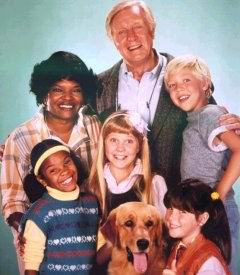
Punky Brewster (Soleil Moon Frye) publicity still

Punky Brewster premiered on NBC on September 16, 1984, and ran through 1988. It starred Soleil Moon Frye as Penelope “Punky” Brewster, a spirited young girl abandoned by her mother, who’s unofficially taken in by Henry Warnimont, a grumpy older photographer and apartment manager who slowly becomes her foster father. Beneath its bright, kid-friendly surface, it was a genuinely tender show about a found family.

Heartbreak under the rainbow

Here’s what people forget about Punky Brewster: the setup is heartbreaking. Punky is a little girl whose mother left her in a shopping-mall parking lot, and she ends up squatting in an empty Chicago apartment with her dog until the building’s gruff manager, Henry (George Gaynes), discovers her. What follows is the slow thaw of a lonely old man and the placement of a kid nobody wanted into a real home. The show wrapped that emotional core in optimism and color, which is exactly why it landed — it earned its sweetness.

Punky Power

Punky’s whole philosophy fit into two words: “Punky Power.” It meant optimism, resilience, and being unapologetically yourself no matter what life threw at you — a message aimed straight at kids and delivered without preaching. Soleil Moon Frye played her with such natural energy that Punky became a genuine role model, and her wildly mismatched, colorful wardrobe turned into a real fashion craze among kids who wanted to dress just like her.

Remember when Punky Brewster aired its famous episode dealing with the Challenger space shuttle disaster — pausing the usual fun to help kids process something real and frightening that had just happened on live TV? It’s the moment the show proved it took its young audience seriously.

The “very special” episodes

Like a lot of 80s kids’ programming, Punky Brewster wasn’t afraid to get serious. It tackled tough subjects — grief, danger, saying no to strangers, the Challenger tragedy — trusting kids to handle real feelings if you framed them with care. That mix of bright, silly fun and unexpectedly heavy lessons is a very 80s combination, and it gave the show a depth that keeps it fondly remembered.

Why Punky Brewster still shines

Punky Brewster proved a kids’ show could be both goofy and genuinely moving — a found-family story with a huge heart and a killer wardrobe. It spun off an animated version, launched Soleil Moon Frye’s career, and even returned decades later for a revival. “Punky Power” and those mismatched socks remain one of the decade’s most endearing images.

FAQ

When did Punky Brewster air?
It premiered September 16, 1984, on NBC and continued in syndication through 1988.

Who played Punky Brewster?
Soleil Moon Frye, in the role that made her a childhood star.

What is the show about?
A young girl abandoned by her mother is taken in by Henry, a gruff older photographer, who becomes her foster father — a warm found-family story.

What was “Punky Power”?
Punky’s catchphrase and philosophy — optimism, resilience, and being yourself no matter what.

Why is the Challenger episode remembered?
The show aired a special episode helping child viewers cope with the 1986 Challenger space shuttle disaster, a notable moment of kids’ TV taking real events seriously.

Was Punky Brewster revived?
Yes — it inspired an animated spinoff and later a revival series decades after the original.


Punky Brewster was one of the biggest hearts on 80s TV — meet the rest of the gang in our 80s pop culture icons guide, or catch the glam of Jem and the Holograms next.
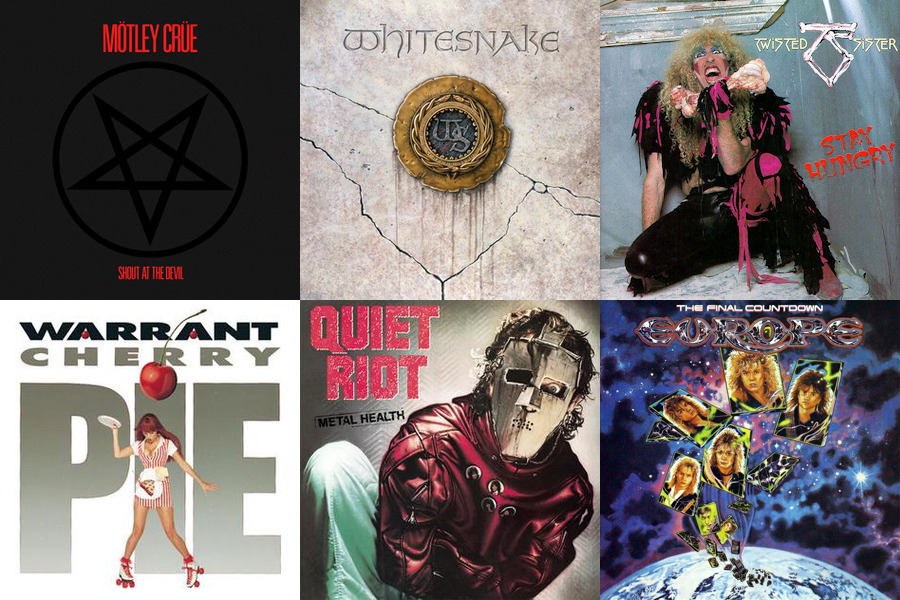
When grunge rolled in around 1991, the conventional wisdom was that hair metal was finished — a punchline, a relic, gone for good. Funny thing, though: three decades later, a huge number of these bands are still out there playing to packed houses, and several of their stars reinvented themselves in ways nobody saw coming. So where did the kings of glam metal actually end up? The answer is: thriving, mostly.

A selection of 1980s hair metal album covers

Many 80s hair bands are still active today — touring on booming nostalgia bills, reuniting for new albums, and, in several cases, reinventing their frontmen entirely. The music never died; it just went from cutting-edge to beloved.

Still filling arenas

  • Bon Jovi never really slowed down, becoming one of the most successful touring acts in the world and landing in the Rock and Roll Hall of Fame.
  • Def Leppard are bigger than ever, headlining massive stadium tours (often co-headlining with fellow legends) and joining the Hall of Fame themselves — with Rick Allen still behind the kit.
  • Mötley Crüe staged one of rock’s great comebacks, reuniting for blockbuster tours after a hit biographical film introduced them to a whole new generation.

Reinvented in surprising ways

  • Poison‘s Bret Michaels became a full-blown mainstream celebrity all over again through reality TV, while still touring with the band.
  • Winger‘s Kip Winger pulled off the most unexpected pivot of all — becoming a genuinely acclaimed classical and orchestral composer, earning the kind of respect the hair-metal label never afforded him.
  • Skid Row kept the flame burning through lineup changes, while former frontman Sebastian Bach built a busy solo and acting career.

The nostalgia boom

Here’s the big-picture truth: the “hair band” nostalgia circuit is now a genuine industry. Package tours stacking three or four of these acts on one bill sell out amphitheaters every summer, drawing original fans and their kids alike. Streaming introduced the anthems to listeners who weren’t alive when they were new, and movies and TV keep dropping the songs into memorable scenes. The genre that was supposedly killed off has quietly become one of the most durable live draws in music.

Remember when everyone assumed this music was gone for good — and now your teenager knows every word to “Livin’ on a Prayer” and “Pour Some Sugar on Me”? The hair bands didn’t disappear. They just waited out the trend that buried them, and the songs turned out to be indestructible.

New albums, not just old hits

Here’s something that surprises people: a lot of these bands never became pure nostalgia acts — they kept making music. Def Leppard, Bon Jovi, and others have continued releasing new albums to loyal fanbases, and reunion records from the likes of Winger earned genuine critical respect rather than eye-rolls. Meanwhile the culture kept handing the old songs fresh life: hits from the era show up constantly in movies, TV shows, video games, and viral clips, introducing “Livin’ on a Prayer,” “Sister Christian,” and “The Final Countdown” to listeners born decades after they were recorded. The result is a genre with an unusually healthy pulse — one foot in the nostalgia economy, the other still creating. For music that was declared dead in 1991, the 80s hair bands have proven remarkably, cheerfully hard to kill.

Why they’re still standing

The lesson of the hair bands’ second act is simple: great hooks don’t expire. Fashions change, critics move on, and whole genres fall in and out of favor — but a chorus built to make an arena sing is forever. These bands may have started as the sound of one specific, hairspray-soaked moment, but they’ve become something more permanent: the reliable, joyful soundtrack of a good time, still going strong. Long live the 80s.

FAQ

Are 80s hair bands still touring?
Yes — many, including Bon Jovi, Def Leppard, Mötley Crüe, Poison, and Skid Row, remain active, often headlining large nostalgia-circuit tours.

Which hair-band star became a reality-TV celebrity?
Poison’s Bret Michaels, who found a whole new mainstream audience through reality television while continuing to tour.

What did Kip Winger do after hair metal?
He became an acclaimed classical and orchestral composer, one of the most surprising reinventions of any 80s rock star.

Why are hair bands popular again?
A booming nostalgia touring circuit, streaming discovery by younger fans, and the songs’ constant use in movies and TV have kept the music thriving.


Take the full tour of the era in our best 80s hair bands guide, or read the surprising story of Winger.

Locked in a room with a bomb ticking down, no gun, no backup — just a paperclip, a stick of chewing gum, and a Swiss Army knife. Where every other 80s action hero would kick down the door, MacGyver would build something out of the doorknob. He was the smartest man on television, and his superpower was a high school science class.

MacGyver (1985) TV series logo

MacGyver premiered on ABC on September 29, 1985, and ran for seven seasons until 1992. It starred Richard Dean Anderson as Angus MacGyver, a resourceful secret agent who solved problems and escaped danger using science, everyday objects, and improvisation instead of weapons. Created by Lee David Zlotoff, it turned brains into the coolest thing on TV and made “MacGyver” a verb.

A hero who hated guns

MacGyver had a genuine point of view, and it ran against the grain of its whole genre. In a decade of Rambos and machine-gun montages, MacGyver refused to carry a firearm. He fought with knowledge — chemistry, physics, engineering — turning household junk into tools, escapes, and gadgets. A candy bar could plug a leak; a chocolate bar and some lye could patch a sulfuric-acid hole. The show even fudged details on purpose so kids wouldn’t build anything dangerous. It was action television that quietly told a generation that being smart was heroic.

Richard Dean Anderson and the mullet heard ’round the world

Anderson made MacGyver likable in a very specific way — calm, understated, a little wry, never showing off despite being the cleverest person in every room. The feathered hair became a defining 80s look, and the character’s laid-back competence made him a role model without a single speech about it. It was the role of Anderson’s career, years before he’d anchor Stargate SG-1.

Remember when MacGyver would get trapped somewhere impossible, the music would go quiet, and the camera would zoom in on some random pile of junk — a battery, a length of wire, a rubber mat — while his voiceover calmly walked you through exactly how he was going to MacGyver his way out? That “here’s what I’ve got to work with” moment was the whole show in a nutshell.

The Phoenix Foundation and a quiet kind of good

MacGyver worked for the Phoenix Foundation and the fictional Department of External Services, taking on missions that were as likely to involve saving a village’s water supply or rescuing kids as stopping a villain. The show leaned earnest and optimistic — MacGyver cared about the environment, science education, and doing right — which gave it a warmth a lot of harder-edged action shows lacked. He was a hero you’d actually want your kid to copy.

Why MacGyver still improvises

The ultimate proof of the show’s cultural dent: the name became a word. To “MacGyver” something is to fix or build it cleverly out of whatever’s lying around — a term that’s outlived the series by decades and landed in the dictionary. A rebooted series arrived years later, but the original’s legacy is bigger than any one show. MacGyver made ingenuity iconic.

FAQ

When did MacGyver air?
It premiered September 29, 1985, on ABC and ran for seven seasons, ending in 1992.

Who played MacGyver?
Richard Dean Anderson, in his signature role as Angus “Mac” MacGyver.

What was MacGyver’s whole gimmick?
He solved problems and escaped danger using science and everyday objects — paperclips, duct tape, chewing gum — rather than guns, which he refused to carry.

Who created MacGyver?
Lee David Zlotoff.

Did the show use real science?
It was grounded in real principles but deliberately altered or omitted key details so viewers couldn’t actually build dangerous devices at home.

Is “MacGyver” really a word now?
Yes — “to MacGyver” something, meaning to improvise a clever fix from whatever’s on hand, entered common use and the dictionary because of the show.


MacGyver was one of the sharpest minds of 80s TV — meet the rest of the class in our 80s pop culture icons guide, or ride along with Knight Rider next.

A sleek black sports car with a red light sweeping back and forth across its nose, purring one-liners in a dry British accent while a guy in a leather jacket and a perm leaned on the hood. Knight Rider took the oldest fantasy a kid can have — a car that’s your best friend — and built a whole primetime hit on it.

Knight Rider (1982) TV series logo

Knight Rider premiered on NBC on September 26, 1982, and ran for four seasons until 1986. It starred David Hasselhoff as Michael Knight, a crime-fighter paired with KITT — the Knight Industries Two Thousand — an artificially intelligent, nearly indestructible Pontiac Firebird Trans Am. Created by Glen A. Larson, it turned a talking car into one of the decade’s most beloved TV icons.

The car was the real star

Let’s be honest about who the audience tuned in for. KITT — voiced by William Daniels in that unflappable, faintly superior tone — was the coolest character on the show. He could drive himself, talk back, scan for danger, deploy gadgets, and hit “Turbo Boost” to leap over obstacles. That scanning red light on the front grille and the digital voice modulator became instantly iconic. Kids didn’t want to be Michael Knight so much as they wanted to ride shotgun with his car.

Hasselhoff before he was The Hoff

Knight Rider made David Hasselhoff a household name years before Baywatch and his oddly enormous music career in Germany. As Michael Knight — a former cop given a new face and a new identity after being left for dead — he was the human anchor the show needed: earnest, good-looking, and happy to let a car steal every scene. It was the role that launched one of the most improbable celebrity runs of the era.

Remember when KITT would hit Turbo Boost and launch the Trans Am off a ramp, soaring over a wall or a river or a line of bad guys in slow motion? It happened constantly, it looked amazing, and no kid watching ever once questioned the physics of it.

A hero on the side of the little guy

The show’s mission statement was pure comic-book morality. Michael and KITT worked for the Foundation for Law and Government (FLAG), backed by the wealthy Wilton Knight’s dying wish: “one man can make a difference.” Each week they’d roll into some town, help ordinary people being pushed around by crooks the law couldn’t touch, and roll out again. It was a Western with a supercar instead of a horse — a lone hero and his impossibly loyal ride.

Why Knight Rider still cruises

Strip it down and Knight Rider is a perfect little 80s machine: one great gimmick, executed with total conviction, wrapped around a hero, a mission, and the coolest car on television. The scanning red light and KITT’s voice are permanent pop-culture shorthand, and the show has been revived and rebooted more than once. Some ideas are just too fun to leave parked.

FAQ

When did Knight Rider air?
It premiered September 26, 1982, on NBC and ran for four seasons, ending in 1986.

What kind of car was KITT?
KITT was a modified 1982 Pontiac Firebird Trans Am, presented as the artificially intelligent “Knight Industries Two Thousand.”

Who voiced KITT?
Actor William Daniels provided KITT’s calm, dry voice — though he went uncredited during the original run at his own request.

Who played Michael Knight?
David Hasselhoff, in the role that made him a star before Baywatch.

Who created Knight Rider?
Prolific TV producer Glen A. Larson, who was also behind shows like Magnum, P.I. and Battlestar Galactica.

What was Turbo Boost?
KITT’s signature gadget — a rocket-assisted jump that let the car leap over walls, ravines, and obstacles, one of the show’s most repeated visual thrills.


Knight Rider was one gear in the machine of 80s TV — see the whole lineup in our 80s pop culture icons guide, or roll out with The A-Team next.

The fedora. The whip. The leather jacket and the five-o’clock shadow and that theme music that makes you sit up straighter just reading about it. Indiana Jones didn’t ease into the 80s — he came sprinting out ahead of a giant boulder and never slowed down.

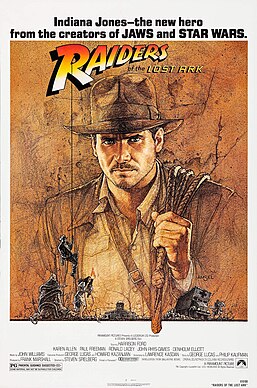
Raiders of the Lost Ark (1981) movie poster

Indiana Jones is the whip-cracking, Nazi-punching archaeologist played by Harrison Ford across three 1980s adventures: Raiders of the Lost Ark (1981), Temple of Doom (1984), and The Last Crusade (1989). Created by George Lucas and directed by Steven Spielberg, he’s the character who made “adventure movie” mean something specific for a whole generation.

Three films that built the legend

  • Raiders of the Lost Ark (1981): the one that started it all — Indy racing Nazis to the Ark of the Covenant. It pulled in over $212 million worldwide and nine Oscar nominations, winning four. The rolling-boulder opening alone taught every kid what a movie could feel like.
  • Temple of Doom (1984): darker, wilder, and so intense it helped trigger the creation of the PG-13 rating. Mine carts, a cult, and “keep calm” thrown right out the window.
  • The Last Crusade (1989): the crowd-pleaser, with Sean Connery as Indy’s exasperated father. The father-son bickering gave the trilogy its warmest, funniest note and sent it out on a high.

An expert who never looks like one

The reason Indy works is that he’s brilliant and a mess at the same time. He’s a genuine scholar — a professor in tweed when he’s not on a dig — but out in the field he’s improvising, bleeding, and terrified of snakes. “It’s not the years, honey. It’s the mileage.” He wins by refusing to quit, not by being untouchable, and that made him a hero you could actually imagine being.

Remember when a swaggering swordsman flourished his blade in a Cairo market, the whole crowd braced for an epic duel — and Indy just sighed, pulled his pistol, and shot him? Reportedly improvised because Ford was sick that day. It’s the single most Indiana Jones moment in the trilogy.

Why he defined the decade

Lucas and Spielberg built Indy as a love letter to old adventure serials, then made him bigger than any of them. Across the 80s he set the template for the modern blockbuster hero: smart, flawed, funny, and relentlessly game. The fedora and whip are so iconic they’ve basically become shorthand for “adventure” itself. Not bad for a professor who’s scared of snakes.

The theme, the homage, and the legacy

Close your eyes and you can hear it: John Williams’ “Raiders March,” maybe the most rousing adventure theme ever written. It does half the character’s work — the second those brass notes hit, you’re already grinning, already ready to run. Williams gave Indy a musical identity as iconic as the fedora.

What’s easy to forget is that Indiana Jones was built as a loving throwback. Lucas and Spielberg dreamed him up as a tribute to the cliffhanger movie serials they grew up on in the 1930s and ’40s — the Saturday-matinee adventures where the hero escaped one deathtrap only to fall into the next. They took that old rhythm, poured a blockbuster budget into it, and created something that felt brand new and comfortingly timeless at once. That’s why the three 80s films still play like the gold standard for adventure movies. The whip, the hat, the theme, the grin under the stubble — Lucas and Spielberg didn’t just make three great movies, they built a hero so complete that “Indiana Jones” became a synonym for adventure itself.

FAQ

What Indiana Jones movies came out in the 80s?
Three: Raiders of the Lost Ark (1981), Indiana Jones and the Temple of Doom (1984), and Indiana Jones and the Last Crusade (1989).

Who created and directed Indiana Jones?
George Lucas created the character; Steven Spielberg directed the films, with Harrison Ford starring.

Who plays Indy’s father?
Sean Connery plays Henry Jones Sr. in The Last Crusade (1989).

Why is Indiana Jones so iconic?
He blends genuine scholarship with reckless, improvised heroics — a smart, flawed, funny hero whose fedora and whip became shorthand for adventure itself.

What is Indiana Jones’s theme music?
“The Raiders March,” composed by John Williams — one of the most triumphant and recognizable pieces of film music ever written. The moment those brass notes hit, you know adventure is coming. It does nearly as much to define the character as the fedora and whip.


Indy set the standard for 80s adventure — find more legends in our 80s movie characters roundup, or swing a sword with Conan the Barbarian next.

If you grew up in the 80s, you didn’t just watch Marty McFly — you wanted to be him. The skateboard, the down vest, the guitar he wasn’t supposed to touch, the way he said “This is heavy” like the whole universe was a minor inconvenience. Marty was the 80s teenager the 80s teenager wished he was.

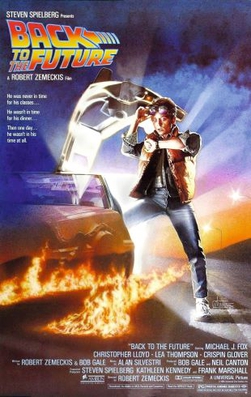
Back to the Future (1985) movie poster

Marty McFly is the fictional hero of Back to the Future, a Hill Valley high-schooler who accidentally rides a DeLorean time machine back to 1955 and nearly erases himself from existence. He was played by Michael J. Fox, created by Robert Zemeckis and Bob Gale, and he turned a summer sci-fi comedy in 1985 into one of the most beloved movies of the decade. But the reason he works — the reason he still feels like a friend you grew up with — has almost nothing to do with the time machine.

The kid, not the plot

Strip away the flux capacitor and here’s what you’ve got: a normal kid with a garage band, a crush he can’t close, a family that embarrasses him, and a best friend who happens to be a mad scientist. That’s it. That’s the whole trick. Zemeckis and Gale built the most relatable teenager in movie history and then handed him a DeLorean.

Marty’s full name is Marty Seamus McFly. He plays guitar, he skateboards everywhere, he’s got a girlfriend named Jennifer and a rejection letter from the school dance committee (his band, The Pinheads, was “just too darn loud”). He’s not a chosen one. He’s not special. He gets pulled into the adventure because his weird old friend Doc Brown parked a time machine in a mall parking lot at 1:15 in the morning.

That ordinariness is what made every kid in 1985 see themselves in him.

The recast almost nobody remembers

Here’s the fact that stops people cold: Michael J. Fox wasn’t the first Marty McFly. Eric Stoltz was originally cast and actually filmed for weeks before the producers made the brutal call that the chemistry wasn’t landing. Fox — juggling a full-time job on the sitcom Family Ties — shot the movie at night, sleeping a few hours between the two. The exhaustion you can’t see on screen became one of the most effortless-looking performances of the decade.

It’s the kind of behind-the-scenes near-miss that makes you realize how close the 80s came to a completely different pop culture. No Fox, no “Great Scott” double act, maybe no franchise at all.

Remember when the Enchantment Under the Sea dance turned into a Chuck Berry origin story? Marty plugs in, plays “Johnny B. Goode,” and accidentally invents rock and roll in front of a 1955 gymnasium — then loses the room the second he shreds a solo twenty years too early. It’s the single most 80s thing a movie ever did.

Why Marty outlasted the decade

Plenty of 80s heroes were bigger, louder, or more armed. Marty was none of those. What he had was charm — the exact thing you can’t manufacture. He’s cool without trying, brave without a speech about it, and he loves his goofball mentor with zero irony. He was listed among the greatest sci-fi characters of all time, and it wasn’t for the science.

He’s Michael J. Fox’s most celebrated role, and he’s the reason a whole generation still can’t see a clock tower without thinking about lightning.

FAQ

Who played Marty McFly?
Michael J. Fox played Marty across the Back to the Future trilogy. Eric Stoltz was cast first and filmed several weeks of footage before being replaced.

What is Marty McFly’s full name?
Marty Seamus McFly.

Who created the character?
Marty was created by writer-director Robert Zemeckis and co-writer Bob Gale for the 1985 film Back to the Future.

What year does Marty travel back to?
He travels from 1985 to 1955 in the first film, using the DeLorean time machine built by Doc Emmett Brown.

Why is Marty McFly so iconic?
Because he’s an ordinary 80s teenager first and a time traveler second — relatable, effortlessly cool, and played by an actor at the absolute peak of his charm.

What kind of car is the DeLorean time machine?
A DeLorean DMC-12 — a real (and famously commercially unsuccessful) sports car whose gull-wing doors and brushed stainless-steel body made it look like nothing else on the road. Doc Brown’s choice turned an obscure automotive footnote into the single most famous movie vehicle of the decade, forever tied to flames, 88 miles per hour, and a flux capacitor.


Marty’s just one face in a whole gallery of characters who defined the decade — see the full lineup in our 80s movie characters roundup, or meet the kids of the Goonies next.

The 80s didn’t just make horror movies — it built the modern horror machine. This was the decade of the slasher boom, of practical-effects gore that has never been topped, of villains who became household names and franchises that still churn today. If you learned to sleep with the closet light on, there’s a good chance an 80s movie is why.

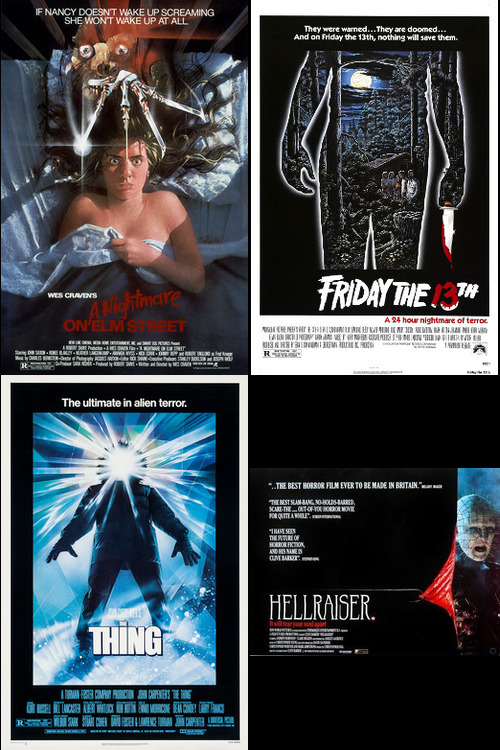
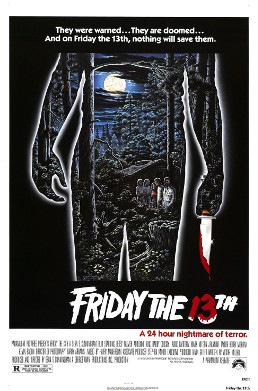
A selection of 1980s horror movie posters

The best 80s horror movies include The Shining (1980), A Nightmare on Elm Street (1984), Friday the 13th (1980), The Thing (1982), Poltergeist (1982), Evil Dead (1981) and Evil Dead II (1987), Aliens (1986), and Hellraiser (1987) — a run that gave horror its most iconic monsters and its greatest practical effects. The decade turned fear into an art form and a business.

The slasher takeover

The 80s belonged to the slasher. Friday the 13th (1980) launched the era’s most relentless franchise and eventually handed us hockey-masked Jason Voorhees, whom we cover in full in our Jason Voorhees profile. Then, in 1984, Wes Craven changed the game with A Nightmare on Elm Street, whose razor-gloved dream-stalker Freddy Krueger — read our Freddy Krueger deep-dive — brought wit and surreal nightmare logic to a genre that had been all knives and shadows.

Together, Jason and Freddy became the twin faces of 80s horror: one silent and unstoppable, one gleefully talkative, both unkillable.

The masters of practical effects

The other great 80s horror story is what filmmakers could do without computers. John Carpenter’s The Thing (1982) remains a high-water mark for creature effects — Rob Bottin’s grotesque, shape-shifting monster still stuns audiences decades later. Sam Raimi’s Evil Dead films fused splatter with slapstick, launching a cult empire and the chainsaw-handed hero Ash. And An American Werewolf in London (1981) featured a transformation scene, courtesy of Rick Baker, so good it basically invented an Oscar category.

The prestige and the sci-fi crossover

Horror also went upscale in the 80s. Stanley Kubrick’s The Shining (1980) turned a haunted hotel into an art film of pure dread, giving us “Here’s Johnny!” and the Grady twins. And the genre bled beautifully into science fiction: James Cameron’s Aliens (1986) weaponized terror into a war movie, while Clive Barker’s Hellraiser (1987) and its Cenobite Pinhead opened a doorway to something stranger and more sadistic.

Remember when renting a horror movie from the video store meant judging it entirely by the terrifying box art — and the cover was often scarier than anything in the film?

Why 80s horror still reigns

The 80s remain the benchmark because the era combined bold ideas with hands-on craft. The monsters were tangible, the kills were inventive, and the villains had personalities strong enough to anchor decade-spanning franchises. Modern horror still returns to these wells constantly — remaking, rebooting, and paying homage. For sheer iconic staying power, no decade of horror has ever matched it.

FAQ

What is the scariest 80s horror movie?
Opinions vary, but John Carpenter’s The Thing (1982) and Kubrick’s The Shining (1980) are frequently named among the most genuinely terrifying, while A Nightmare on Elm Street haunted a generation’s dreams.

Who are the most famous 80s horror villains?
Freddy Krueger from A Nightmare on Elm Street and Jason Voorhees from the Friday the 13th series are the era’s defining icons, joined by Pinhead from Hellraiser.

Why were 80s horror effects so good?
The era relied on practical, hands-built effects — animatronics, prosthetics, and makeup by artists like Rob Bottin and Rick Baker — creating tangible monsters that many fans feel still outdo modern CGI.

When did the slasher boom start?
Halloween (1978) lit the fuse, but Friday the 13th (1980) kicked off the 80s slasher gold rush, followed by A Nightmare on Elm Street in 1984.

Are any 80s horror movies also sci-fi?
Yes — The Thing, Aliens, and The Fly (1986) all blur horror and science fiction, using alien or scientific threats to deliver their scares.


Many of these became midnight-movie staples — cross over to our 80s cult classics roundup, or meet the man of your nightmares in the Freddy Krueger profile.

Most TV shows are made by the people you never see. Dance Party USA was the opposite — the whole show was the people you saw. No script, no professional choreography, no Hollywood cast. Just a floor full of real teenagers, and the ones who came back every day became something the tri-state area had never quite seen before: famous kids from down the block.

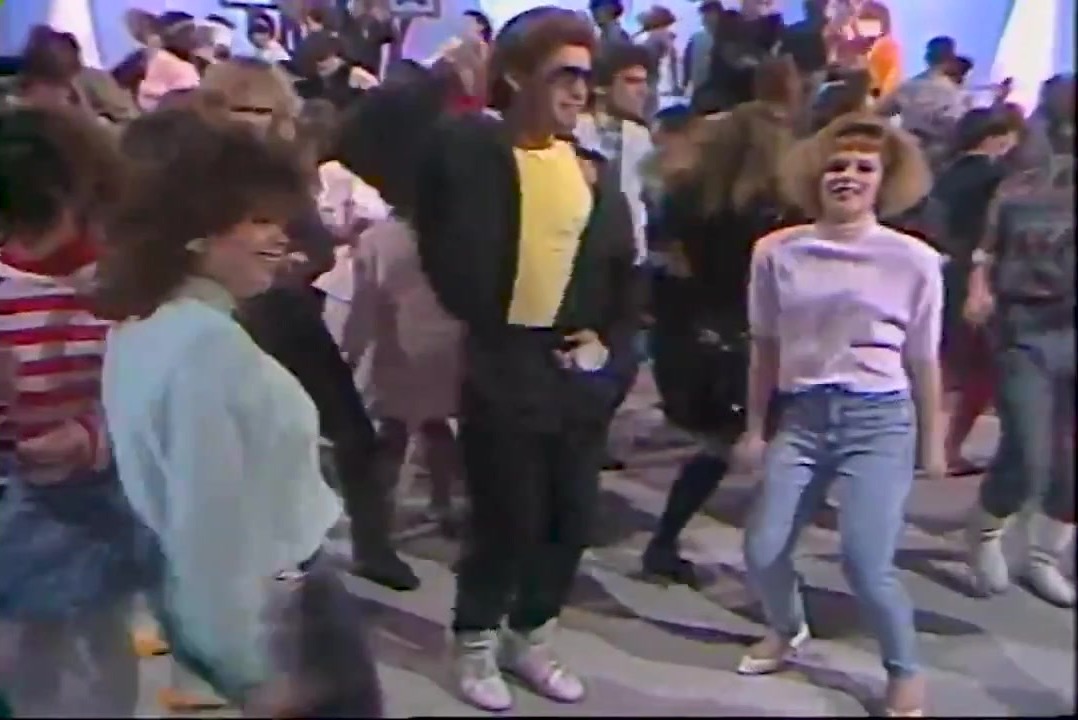
Teen dancers fill the Dance Party USA studio floor, from a late-80s promo tape

The Dance Party USA dancers were regular teens, not professional performers — the show deliberately used everyday kids instead of trained dancers, actors, or writers, and its most consistent regulars became genuine local celebrities across the Philadelphia and tri-state area. That authenticity was the entire point. You didn’t watch polished pros; you watched kids who looked exactly like your friends, and you picked favorites.

Real kids, not a cast

Here’s the thing that separated Dance Party USA from a slick network production: it had no cast in the traditional sense. The show didn’t hire actors, writers, or professional dancers. It filled the studio with ordinary teenagers and let them dance to the hits, and that unforced realness is exactly why it worked. The awkwardness, the confidence, the invented moves — all of it was real, because the kids were real.

That’s also why the regulars mattered so much. When there’s no script, the personalities are the show.

The regulars and their nicknames

The standout dancers earned on-camera nicknames and loyal followings — the kind of shorthand fame that meant viewers tuned in to see specific people. Names like Heather “Princess” Day, Alvin “Spicy” Ramirez, Tyrone “Mr. Mitch” Mitchell, and Romeo King became familiar to daily viewers, while fan favorite Heather Henderson was known to everyone simply as “Baby Heather.” These weren’t stage names handed out by producers — they were identities the audience latched onto.

Among those regulars were two Jersey kids named Bobby Catalano and Jason Pascoe. Bobby came up through the floor and rose to host the show from 1989 to 1991; Jason danced right alongside him. Decades later, the two turned those years into Bobby and Jason’s Awesome 80s Podcast — you can read Bobby’s full story here and Jason’s here.

Remember when being a Dance Party USA regular meant getting recognized at the mall in your own hometown? For the tri-state kids who watched, the dancers on that floor were the coolest people around — and they were reachable, local, real.

Local fame, real memories

The regulars got fan mail. They got stopped in public. In a region where the show was a genuine phenomenon, being one of its dancers was a real kind of stardom — smaller than Hollywood, but somehow more personal, because the fans were neighbors. That’s the magic Dance Party USA bottled: it made celebrities out of the kid next door, and it gave a whole generation the feeling that TV was something you could actually be part of.

And if the regulars are who you came for, WatchParty USA’s regulars archive keeps show-era profiles of the whole crew.

FAQ

Were the Dance Party USA dancers professionals?
No. The show deliberately used regular teenagers rather than professional dancers, actors, or writers — that everyday authenticity was central to its appeal.

How did dancers become regulars on the show?
Consistent dancers who kept coming back and connected with the audience became regulars, earning on-camera nicknames and their own followings among daily viewers.

Who were some famous Dance Party USA regulars?
Regulars included Heather “Princess” Day, Alvin “Spicy” Ramirez, Tyrone “Mr. Mitch” Mitchell, Romeo King, and “Baby Heather” Henderson, plus Bobby Catalano, who rose from regular to host.

Did the dancers become local celebrities?
Yes. In the Philadelphia and tri-state area where the show was hugely popular, the regular dancers were recognized in public and received fan mail — real, if regional, stardom.

Are any Dance Party USA dancers still active today?
Several stay connected to the show’s legacy. Former regulars Bobby Catalano and Jason Pascoe now co-host an 80s nostalgia podcast built on their years on the show.


The dancers made the show — now hear it from two of them in our Bobby Catalano profile, or go back to what Dance Party USA was.

That white hockey mask. Silent, blank, splashed against the dark of Camp Crystal Lake — it might be the single most recognizable image in horror. But here’s the twist most people don’t know: Jason Voorhees didn’t wear it in the movie that made him famous. The mask was almost an accident.

Friday the 13th (1980) movie poster

Jason Voorhees is the silent, machete-wielding killer of the Friday the 13th franchise, who stalked victims around Camp Crystal Lake across the 1980s and became one of the decade’s defining horror icons. He’s non-verbal, seemingly indestructible, and instantly known by a mask he didn’t even have at first.

The mask was a Part III accident

In the original Friday the 13th (1980), the killer isn’t even Jason — it’s his grieving mother, Pamela Voorhees. Jason, who drowned as a boy at the camp, doesn’t take over as the killer until Part 2 — and in that film he wears a burlap sack with a single eyehole, not a hockey mask.

The iconic mask didn’t arrive until Friday the 13th Part III (1982). And the reason is pure luck: a 3D effects supervisor named Martin Jay Sadoff, a hockey fan, happened to have a bag of gear on set — including a Detroit Red Wings goaltender mask. They used it for a quick test, the director loved the look, and they enlarged it and made a new mold. A throwaway prop became one of the most famous faces in film.

Why the blank mask works so well

The genius of Jason is what you don’t get. He never speaks. He never runs. He just appears — a silent, unstoppable wall of a man in an expressionless mask. That blankness lets your imagination do the scaring. There’s no personality to reason with, no motive to appeal to, no face to read. He’s less a character than a force of nature, and the mask is the perfect blank canvas for your own dread.

Remember when every kid at a sleepover knew the drill — the second you heard that “ki-ki-ki, ma-ma-ma” whisper on the soundtrack, somebody was about to get got? That sound was Jason’s calling card, and it could clear a room of brave 12-year-olds in a heartbeat.

The franchise that would not die

Fittingly for a villain who keeps getting back up, Jason powered one of the most relentless franchises in film. Sequel piled on sequel all through the 80s, each one finding a fresh way to bring him back from a death that should have stuck. The series got so inventive it eventually shot him into outer space (Jason X) and pitted him against horror’s other icon in Freddy vs. Jason (2003) — the crossover slasher fans had dreamed about for two decades.

Through all of it, the appeal never changed: the mask, the machete, the silence, and the certainty that he is coming and cannot be stopped. Jason became a Halloween-costume staple, a pop-culture shorthand for the unkillable slasher, and one of the most recognizable movie villains ever created — all built on a character who barely moves and never says a word. That white hockey mask, born from a hockey fan’s spare gear on a 1982 set, turned into one of the most famous faces in cinema. Not bad for a prop that was almost too small to use.

Why he endures

Jason Voorhees became 80s horror shorthand: the masked slasher, the summer-camp nightmare, the villain who simply will not stay down. Sequel after sequel kept him going, and his hockey mask escaped the movies entirely to become a Halloween staple and a pop-culture symbol. Not bad for a look that started as one hockey fan’s spare equipment.

FAQ

When did Jason Voorhees get his hockey mask?
In Friday the 13th Part III (1982). Before that he wore a burlap sack in Part 2, and in the 1980 original the killer was actually his mother, Pamela.

Where did the hockey mask come from?
A 3D effects supervisor and hockey fan had a Detroit Red Wings goalie mask on set; it was used in a test, the director liked it, and it was enlarged for the film.

Does Jason Voorhees speak?
No — he’s a silent, non-verbal killer, which is a big part of what makes him frightening.

Where do the Friday the 13th movies take place?
Largely around Camp Crystal Lake, where Jason drowned as a boy.


Jason and Freddy define 80s horror — read the Freddy Krueger profile next, or browse the full 80s movie characters roundup.

The riff kicks in, the drums crash, and suddenly it’s 1984 again — MTV blasting, big hair everywhere, and one of the tightest hooks the Sunset Strip ever produced. “Round and round… with love we’ll find a way, just give it time.” Ratt didn’t have the longest run of the glam-metal bands, but for one blazing stretch they owned the scene they helped build.

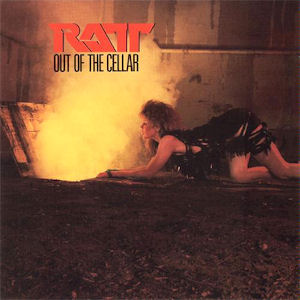
Ratt – Out of the Cellar (1984) album cover

Ratt is the Los Angeles glam-metal band whose 1984 debut Out of the Cellar — powered by the smash single “Round and Round” — made them one of the biggest acts of the early hair-metal wave. Sharp, sleazy, and stacked with hooks, they were the Strip’s breakout success.

Out of the Cellar and a breakout hit

Out of the Cellar landed in 1984 on Atlantic Records and hit immediately — heavy radio play, constant MTV rotation, and eventually triple-platinum sales. The album shot Ratt straight to the top of the Los Angeles glam-metal scene and stands as their most successful release.

The engine was “Round and Round,” Ratt’s biggest hit, which climbed to No. 12 on the Billboard Hot 100 in 1984. With Warren DeMartini’s slick guitar work and a chorus built to stick, it became one of the defining songs of the early hair-metal explosion — later landing on VH1’s lists of the greatest songs of the 80s and the greatest hard-rock songs of all time.

The comedy legend hiding in the video

Here’s the detail that makes the “Round and Round” video unforgettable: it features a cameo by Milton Berle — “Uncle Miltie,” one of the biggest names in the history of American television — appearing in his classic comedic drag character. How does a glam-metal band land a TV legend? Berle’s nephew, Marshall Berle, was Ratt’s manager. The bizarre, funny cameo helped the video stand out on MTV and gave the song a huge boost. A vaudeville-era comedy giant helped break a Sunset Strip metal band. Only in the 80s.

Remember when the “Round and Round” riff was basically a signal flare for the whole hair-metal movement about to detonate? Ratt got there early — before the Strip was crowded — and for a moment they were the biggest thing to come off it. That first-mover swagger is all over the record.

Why Ratt endures

Ratt never quite matched the sales heights of the Bon Jovis and Def Leppards, but their influence on the early glam-metal sound is undeniable — they helped define the template everyone else followed off the Sunset Strip. “Round and Round” remains a staple of any serious 80s playlist, and the band’s tight, hook-driven attack still sounds like the moment the party started. Sometimes being first is its own legacy.

The Sunset Strip blueprint

Ratt’s importance goes beyond “Round and Round.” Along with a handful of peers, they were among the bands that actually built the L.A. Sunset Strip glam-metal scene — the clubs, the look, the sleazy-but-catchy sound that dozens of bands would chase in the years after. Out of the Cellar and its follow-ups leaned on Warren DeMartini and Robin Crosby’s twin-guitar attack and Stephen Pearcy’s snarling delivery to create a template: hooks sharp enough for radio, attitude dirty enough for the Strip. When later bands flooded MTV with the same formula, they were, in part, following the trail Ratt helped blaze. Being an architect of a scene is a quieter legacy than selling the most records — but without bands like Ratt getting there first, the party might never have started.

FAQ

What is Ratt’s biggest hit?
“Round and Round,” which reached No. 12 on the Billboard Hot 100 in 1984.

What is Ratt’s most successful album?
Out of the Cellar (1984), certified triple platinum and the record that broke them nationally.

Who appears in the “Round and Round” music video?
TV comedy legend Milton Berle, in his drag character — his nephew Marshall Berle was Ratt’s manager.

Where is Ratt from?
Los Angeles, where they were one of the breakout bands of the Sunset Strip glam-metal scene.

Who were the guitarists in Ratt?
Warren DeMartini and Robbin Crosby formed the band’s twin-guitar attack, a defining part of their sharp, hook-driven Sunset Strip sound, with Crosby also serving as one of Ratt’s primary songwriters.


Ratt helped light the fuse — see who followed in our best 80s hair bands guide, or turn it up with Mötley Crüe next.

Scroll to top