Year: 2026

One glittering glove. One backward glide across a stage that looked like the floor had turned to ice. One album so enormous it still sits at the top of the all-time list. When people talk about who ruled the 1980s, the conversation starts and often ends in the same place: Michael Jackson. He didn’t just have the decade’s biggest hits — he redefined what a pop star could be.

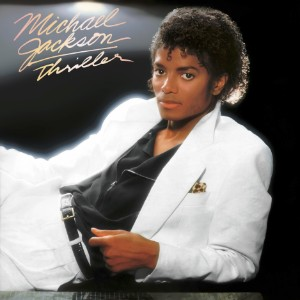
Michael Jackson – Thriller (1982) album cover

Michael Jackson is the King of Pop who dominated the 1980s with the best-selling album of all time, Thriller (1982), its blockbuster follow-up Bad (1987), and performances that changed music and television forever. No one loomed larger over the decade.

Thriller and Bad: the numbers that broke records

Jackson entered the 80s as a rising solo star off Off the Wall (1979), then detonated the culture with Thriller in 1982 — the best-selling album in history, a record it still holds. It spun off hit after hit: “Billie Jean,” “Beat It,” and the title track. Then he did the near-impossible and followed it with Bad (1987), which became the first album ever to produce five No. 1 singles on the Billboard Hot 100: “I Just Can’t Stop Loving You,” “Bad,” “The Way You Make Me Feel,” “Man in the Mirror,” and “Dirty Diana.” Two era-defining albums, back to back.

The night he changed everything

Here’s the single most electric moment of Jackson’s decade. On the TV special Motown 25, broadcast in 1983 to an audience estimated around 47 to 50 million people, Jackson performed “Billie Jean” in a rhinestone-studded glove — and debuted the moonwalk. That gliding-backward step (which he’d been taught a few years earlier by dancer Jeffrey Daniel) became his signature move on the spot, and the performance is remembered as one of the defining moments in pop history. In a matter of minutes, he went from superstar to legend.

The videos that broke barriers

Jackson didn’t just make songs; he made events. His music videos for “Billie Jean,” “Beat It,” and the 14-minute mini-movie “Thriller” transformed the music video from a promo clip into a genuine art form. Just as importantly, their heavy rotation is credited with helping break racial barriers on MTV, which had been slow to feature Black artists. The “Thriller” video alone — with its zombie dance and cinematic scope — reset everyone’s expectations for what the medium could do.

Remember when the “Thriller” video premiered like a movie event — and suddenly every kid on the playground was trying to do the zombie dance? For a while, Michael Jackson wasn’t just a musician. He was the center of gravity for all of pop culture, and everyone was pulled into his orbit.

Why he defined the decade

Michael Jackson’s 80s run is arguably the most dominant stretch any pop artist has ever had — record-shattering sales, genre-blending songs, revolutionary videos, and dance moves the whole world tried to copy. He turned the album, the music video, and the live performance all into event-level art at the same time. When we picture the sound and spectacle of the 1980s, the King of Pop is right at the center of it.

FAQ

What are Michael Jackson’s biggest 80s albums?
Thriller (1982), the best-selling album of all time, and Bad (1987), the first album to produce five No. 1 Hot 100 singles.

When did Michael Jackson first do the moonwalk?
He debuted it performing “Billie Jean” on the Motown 25 TV special, broadcast in 1983 to an audience of roughly 47–50 million.

Why were his music videos so important?
Videos like “Billie Jean,” “Beat It,” and “Thriller” turned the form into an art form and helped break racial barriers on MTV.

Why is Michael Jackson called the King of Pop?
His record-breaking 80s sales, revolutionary videos, and global influence on music and dance earned him the title.

How many copies did Thriller sell?
Thriller is the best-selling album in history, with estimated worldwide sales well over 60 million copies — a record it has held for decades.

What are Michael Jackson’s most famous 80s songs?
“Billie Jean,” “Beat It,” “Thriller,” “Bad,” “Smooth Criminal,” “The Way You Make Me Feel,” and “Man in the Mirror,” among many others.

Did Michael Jackson influence 80s fashion?
Enormously — the single sequined glove, the red leather “Thriller” jacket, and the military-style outfits became instantly copied fashion statements around the world.


Michael Jackson ruled 80s pop — explore more in our 80s pop culture guide, or meet his great rival Prince next.
A black-and-red GMC van, a plan coming together, and roughly ten thousand rounds of ammunition fired every week without anybody actually getting hurt. If you were a kid in the 80s, The A-Team wasn’t a show — it was an event, and it always ended the same gloriously satisfying way: the bad guys’ truck flips over, they crawl out dazed, and the good guys drive off.

The A-Team (1983) TV series title card

The A-Team premiered on NBC on January 23, 1983, and ran for five seasons until 1987. It followed four Vietnam vets — framed for “a crime they didn’t commit,” on the run from the military, and working as soldiers of fortune who help the little guy. Created by Stephen J. Cannell and Frank Lupo, it became one of the decade’s biggest action hits by being cartoonishly violent and completely harmless at the same time.

The four guys everybody could name

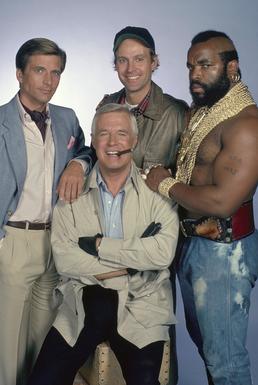
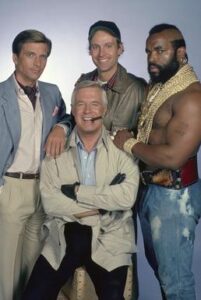
The genius was the team itself. Colonel John “Hannibal” Smith (George Peppard) was the cigar-chomping mastermind who loved it when a plan came together. Templeton “Faceman” Peck (Dirk Benedict) was the smooth-talking con artist who could scam anything they needed. “Howling Mad” Murdock (Dwight Schultz) was the unhinged pilot the others sprang from a mental hospital every episode. And B.A. Baracus (Mr. T) was the gold-draped, mohawked mechanic who could weld a tank out of a tractor by lunchtime — and was terrified of flying.

Four archetypes, instantly readable, endlessly repeatable. Every kid on the playground knew exactly which one he wanted to be.

Mr. T becomes a phenomenon

The A-Team made Mr. T one of the most recognizable humans on the planet. The gold chains, the mohawk, the “I pity the fool” attitude, the growl — B.A. Baracus jumped straight off the screen into cartoons, cereal, action figures, and a whole cottage industry of catchphrases. For a couple of years there, you genuinely could not escape him. He was less a TV character than a national mascot.

Remember when the team would get locked in a barn or a warehouse by the bad guys — and instead of panicking, they’d find a pile of scrap metal and a welding torch and build an armored assault vehicle out of it, montage and all? That “captured-guys-build-a-tank” sequence happened so often it basically became the show’s signature move.

The violence that never drew blood

Here’s the odd magic of The A-Team: it was one of the most explosive shows on television, and almost nobody ever died. Cars flipped, machine guns roared, buildings blew up — and the occupants always staggered out shaken but fine. It was action as pure spectacle, engineered to thrill kids without alarming parents. Critics rolled their eyes; audiences didn’t care. That weightless, consequence-free bang is exactly what makes it feel so unmistakably 80s.

Why the A-Team still rolls

The show’s a time capsule of a very specific kind of 80s fun: loud, dumb in the best way, built around four guys you’d follow anywhere, and wrapped up in under an hour with a bad guy in a flipped truck. It spawned a 2010 movie and a permanent place in pop-culture shorthand. When someone says “I love it when a plan comes together,” they’re quoting Hannibal Smith, whether they know it or not.

FAQ

When did The A-Team air?
It premiered January 23, 1983, on NBC and ran for five seasons, ending in 1987.

Who were the members of the A-Team?
Hannibal Smith (George Peppard), Templeton “Faceman” Peck (Dirk Benedict), “Howling Mad” Murdock (Dwight Schultz), and B.A. Baracus (Mr. T).

Who created The A-Team?
It was created by Stephen J. Cannell and Frank Lupo.

What was B.A. Baracus afraid of?
Flying. The team constantly had to trick or sedate B.A. to get him on a plane or helicopter — a running gag across the whole series.

Why did the A-Team never seem to kill anyone?
The show was deliberately made as bloodless action spectacle — endless gunfire and explosions, but villains almost always survived — to keep it thrilling for kids without being too graphic.

What was Hannibal’s catchphrase?
“I love it when a plan comes together,” usually delivered with a cigar as the episode’s scheme paid off.


The A-Team was one engine in a golden age of 80s TV — see the whole lineup in our 80s pop culture icons guide, or shift into high gear with Knight Rider next.

The 80s might be the single greatest decade for comedy the movies ever had. It was the era when Saturday Night Live and SCTV alumni took over the big screen, when raunch and heart learned to share a scene, and when a generation of quotable, rewatchable classics got made almost by accident. These are movies you don’t just watch — you recite.

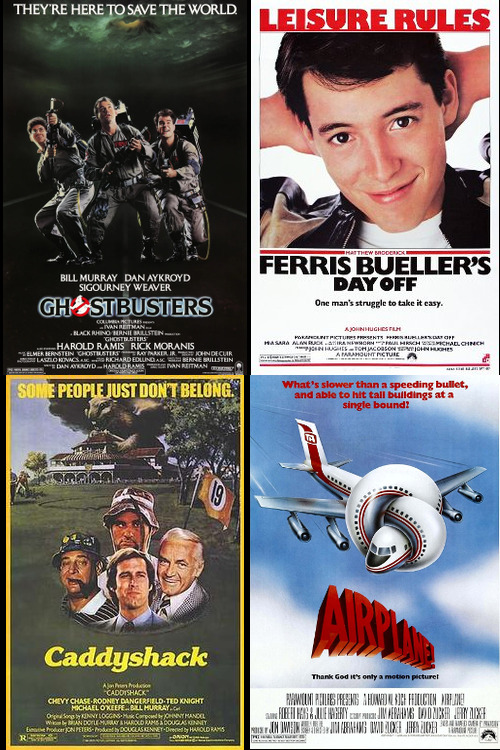
A selection of 1980s comedy movie posters

The best 80s comedies include Ghostbusters, Caddyshack, Ferris Bueller’s Day Off, Airplane!, Trading Places, Coming to America, Beverly Hills Cop, and Planes, Trains and Automobiles — a run of films powered by comedy legends like Bill Murray, Eddie Murphy, and the whole John Hughes universe. They defined what funny looked like for a decade, and most of them still land today.

The comedy powerhouses

If the 80s comedy boom had a face, it was Bill Murray. Caddyshack (1980), Stripes (1981), and especially Ghostbusters (1984) turned his deadpan, improvisational cool into the template every comic actor chased. Ghostbusters in particular was a phenomenon — a supernatural comedy blockbuster that spawned a theme song, a cartoon, and endless quotes.

Right beside him stood Eddie Murphy, who owned the decade like few others. 48 Hrs. (1982), Trading Places (1983), Beverly Hills Cop (1984), and Coming to America (1988) made him the biggest comedy star on the planet, blending motor-mouth charisma with real leading-man presence. If you want the deep dive, meet his most iconic role in our Axel Foley profile.

The spoof and the gross-out

The 80s also perfected two very different comedy engines. On one end, the rapid-fire parody: Airplane! (1980) from the ZAZ team (Zucker, Abrahams, Zucker) crammed more jokes per minute than anyone thought possible and made “don’t call me Shirley” immortal. On the other end, the anarchic ensemble: National Lampoon’s Vacation (1983), Ghostbusters, and the teen sex comedies that defined a certain kind of 80s multiplex afternoon.

The Hughes touch

No conversation about 80s comedy is complete without John Hughes, who fused laughs with genuine feeling. Ferris Bueller’s Day Off (1986) is the sunniest hooky-day fantasy ever filmed, and Planes, Trains and Automobiles (1987) — pairing Steve Martin and John Candy — is a comedy that sneaks up and breaks your heart in the last five minutes. His entire filmography is worth its own tour, which we give it in our John Hughes movies guide.

Remember when you and your friends could quote an entire movie start to finish — every line of Ghostbusters or Caddyshack — just from watching it on cable a hundred times? That’s the 80s comedy superpower.

Why they still hold up

The best 80s comedies survive because they were built on character and craft, not just topical gags. Bill Murray’s timing, Eddie Murphy’s charm, the ZAZ team’s precision, and Hughes’s heart don’t age. These movies gave us jokes we still tell, characters we still love, and a comfort-food quality that keeps pulling us back. Put any of them on tonight and the laughs arrive right on schedule.

FAQ

What is the best 80s comedy?
It’s endlessly debated, but Ghostbusters (1984) is the most common pick — a genre-blending blockbuster that was both a massive hit and endlessly quotable. Ferris Bueller’s Day Off and Caddyshack are perennial contenders.

Who were the biggest comedy stars of the 80s?
Bill Murray and Eddie Murphy led the pack, alongside talents like Steve Martin, John Candy, Dan Aykroyd, and Chevy Chase, plus the ensemble of young actors in John Hughes’s films.

What made 80s comedies different?
They ranged from rapid-fire spoofs like Airplane! to heartfelt character comedies like Planes, Trains and Automobiles, and they produced an unusually high number of endlessly quotable, rewatchable classics.

Is Ghostbusters a comedy?
Yes — it’s a supernatural comedy blockbuster, blending big-budget special effects with the improvisational humor of Bill Murray, Dan Aykroyd, and Harold Ramis.

What John Hughes movies are comedies?
Ferris Bueller’s Day Off, Weird Science, Uncle Buck, and Planes, Trains and Automobiles are among his funniest, though most of his films mix comedy with genuine emotion.


Comedy was just one genre the decade owned — see the funniest faces in our 80s movie characters hub, or take the full John Hughes movies tour next.

Some 80s bands wanted to scare your parents. Poison just wanted to throw the best party in town — and for a few glorious years, they did. Bigger hair, brighter makeup, and a grin that said the whole thing was supposed to be fun. Then they wrote one heartbroken ballad and proved there was more under the glitter than anyone expected.

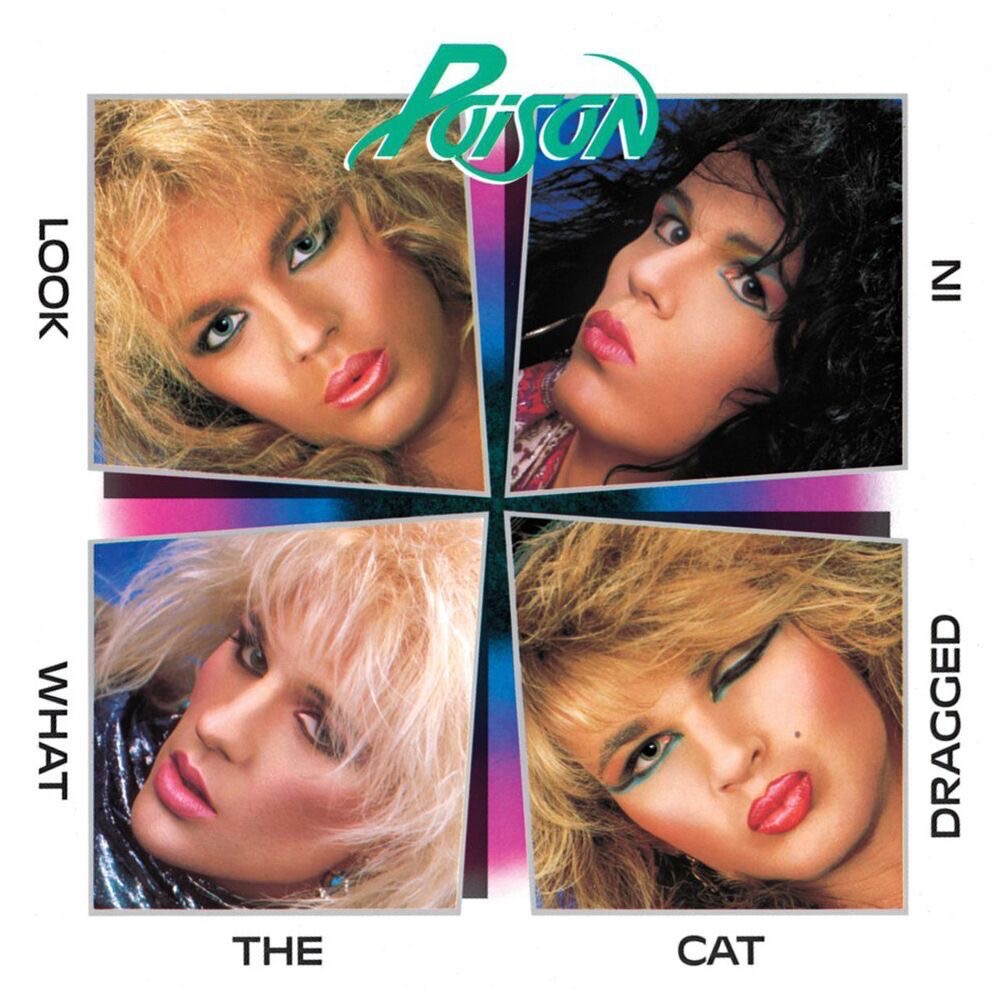
Poison – Look What the Cat Dragged In (1986) album cover

Poison is the glam-metal band formed in Mechanicsburg, Pennsylvania in 1983 — Bret Michaels, C.C. DeVille, Bobby Dall, and Rikki Rockett — who became one of the biggest party-rock acts of the decade before scoring a No. 1 power ballad. They sold over 65 million records selling pure, unapologetic good times.

The party and the ballad

Poison’s early hits were sunshine in spandex: “Talk Dirty to Me,” “Nothin’ But a Good Time,” “I Won’t Forget You” — anthems built for cranking the windows down. They looked like a candy store exploded and they sounded like a Friday night. That should have been the whole story.

Then came “Every Rose Has Its Thorn.” Released in late 1988, the aching acoustic ballad became Poison’s signature song and their only No. 1 hit, topping the Billboard Hot 100 for three weeks starting on Christmas Eve 1988. It crossed over to pop and country — a rare feat for a hair band — and showed there was a real songwriter behind the eyeliner.

The payphone that wrote a No. 1 hit

The story behind that ballad is pure heartbreak, and it’s a great one. Bret Michaels wrote it after a gig in Dallas, when he stopped at a laundromat, found a payphone, and called his girlfriend back in Los Angeles — only to hear another man’s voice on the other end of the line. He poured the gut-punch into a song, framing his fame as the rose and the lost relationship as the thorn. A cheating phone call in a laundromat became one of the biggest ballads of the decade.

Remember when a lighter went up at every show the second those opening acoustic notes of “Every Rose” hit? For a band built on party anthems, their most enduring moment turned out to be the sad one — the whole arena swaying, singing a breakup back to the guy who lived it.

Why Poison endures

Poison kept the hits coming into the 90s and never really stopped touring — Bret Michaels became a genuine celebrity all over again through reality TV decades later, proving that grin still sells. But their 80s peak is the good stuff: a band that understood rock could be pure joy, wrapped in the loudest, brightest package the decade could produce. Nothin’ but a good time, indeed — with one perfect thorn.

More than a one-ballad band

It’s easy to remember Poison for “Every Rose” alone, but their run of party anthems was genuinely deep. “Talk Dirty to Me” and “Nothin’ But a Good Time” are still staples of any 80s playlist, and guitarist C.C. DeVille brought a wild, unpredictable energy that made the band feel like the party might spin out of control at any second — which was exactly the point. Their debut Look What the Cat Dragged In and the follow-up Open Up and Say… Ahh! both went multi-platinum, and their videos were MTV fixtures. Poison understood something a lot of their peers forgot: rock didn’t have to be dark or dangerous to matter. Sometimes it just had to be an unbeatable good time, and few bands delivered that better.

FAQ

Who are the members of Poison?
The classic lineup is Bret Michaels (vocals), C.C. DeVille (guitar), Bobby Dall (bass), and Rikki Rockett (drums).

What is Poison’s only No. 1 hit?
“Every Rose Has Its Thorn,” which topped the Billboard Hot 100 for three weeks beginning December 24, 1988.

What inspired “Every Rose Has Its Thorn”?
Bret Michaels wrote it after calling his girlfriend from a Dallas laundromat payphone and hearing another man’s voice — the heartbreak became the song.

What are Poison’s biggest party anthems?
“Talk Dirty to Me,” “Nothin’ But a Good Time,” “Unskinny Bop,” and “Fallen Angel.”

How many records has Poison sold?
Over 65 million records and DVDs worldwide.

Where is Poison from?
The band formed in Mechanicsburg, Pennsylvania, in 1983, then relocated to Los Angeles to make their name on the Sunset Strip glam-metal scene.


Poison brought the fun — find the whole lineup in our best 80s hair bands guide, or get bluesy with Cinderella next.

A mountain of muscle, a giant sword, and a glower that could stop a charging horse. Before Arnold Schwarzenegger was the Terminator, before he was a one-liner machine, he was Conan — and this is the movie that convinced Hollywood the Austrian bodybuilder could actually carry a film.

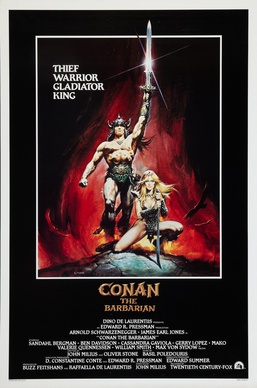
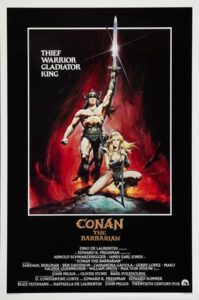
Conan the Barbarian (1982) movie poster

Conan the Barbarian is the vengeance-driven warrior played by Arnold Schwarzenegger in the 1982 sword-and-sorcery epic, a man who crosses a brutal prehistoric world to avenge the parents slaughtered when he was a boy. It was Arnold’s breakthrough role, and it kicked off the fantasy-adventure craze that ran through the decade.

The story: revenge, forged in iron

Orphaned when the necromancer Thulsa Doom and his snake cult destroy his village, young Conan is enslaved and grows into a hardened warrior. Freed, he sets off across the savage landscape of the mythical Hyborian Age hunting the man who murdered his family and stole his father’s sword. It’s simple, mythic, and blood-soaked — directed by John Milius from a script he co-wrote with a young Oliver Stone, based on the pulp hero created by Robert E. Howard back in the 1930s.

The role that built a superstar

Conan was Schwarzenegger’s break-through as an actor. The part played perfectly to his strengths: he didn’t need pages of dialogue, he needed presence — and presence he had in abundance. He performed most of his own stunts, and the production forged two swords for the character at a cost of around $10,000 each, treating the weapon like a co-star. The gamble paid off: within two years Arnold would be The Terminator, and one of the biggest movie stars on Earth.

Remember when Conan is asked what is best in life, and rumbles back, “To crush your enemies, see them driven before you, and to hear the lamentations of their women”? It’s over-the-top, it’s absurd, and it became one of the most quoted lines of 80s fantasy — the whole genre’s swagger in one sentence.

The score, the villain, and the road to the Terminator

Two things elevate Conan above the wave of imitators it inspired. First, the villain: James Earl Jones as the serpent-cult leader Thulsa Doom, bringing that unmistakable voice and a hypnotic, genuinely unsettling menace to what could have been a cardboard bad guy. Second, the music: Basil Poledouris’ thunderous orchestral score, widely considered one of the greatest in all of fantasy film — the kind of soundtrack that makes a man swinging a sword feel like myth.

And then there’s what it launched. Conan the Barbarian proved Arnold Schwarzenegger could open a movie on presence alone, and Hollywood took the hint. A sequel, Conan the Destroyer, followed in 1984 — the very same year Arnold uttered “I’ll be back” as The Terminator and rocketed to global superstardom. In other words, the grim, blood-soaked barbarian epic was the launchpad for one of the biggest movie careers of the century. Conan raised his sword, and an era of larger-than-life 80s action stars marched out behind him.

Why Conan endures

Conan the Barbarian stands as a pillar of 80s fantasy adventure — the movie that helped kick the sword-and-sorcery boom into gear and, more importantly, revealed a star. It’s grand, grim, and gloriously excessive, exactly the kind of larger-than-life spectacle the decade loved. And it all rests on one unforgettable image: Arnold, sword raised, planting the flag for a whole new kind of movie hero.

FAQ

Who plays Conan the Barbarian?
Arnold Schwarzenegger, in the 1982 film that became his breakthrough role.

Who directed Conan the Barbarian?
John Milius, who co-wrote the screenplay with Oliver Stone, based on Robert E. Howard’s pulp character.

What’s Conan’s motivation?
Revenge — he hunts the cult leader Thulsa Doom, who killed his parents and destroyed his village when Conan was a boy.

What’s the famous “what is best in life” line?
“To crush your enemies, see them driven before you, and to hear the lamentations of their women” — one of 80s fantasy’s most quoted lines.

Who composed the Conan the Barbarian score?
Basil Poledouris, whose thunderous orchestral music is widely ranked among the greatest scores in all of fantasy film. Paired with James Earl Jones’s hypnotic villain Thulsa Doom, it helped lift Conan above the many sword-and-sorcery imitators that followed in its wake.


Conan launched the 80s fantasy boom — find more legends in our 80s movie characters roundup, or raise the Sword of Power with He-Man next.

In the 80s, the soundtrack wasn’t an afterthought — it was often the reason a movie became immortal. This was the decade that fused film and pop music into a single marketing supernova, where a hit song could sell a movie and a movie could mint a hit song. Hear a few opening bars today and the whole film comes flooding back. That’s not an accident. That’s 80s engineering.

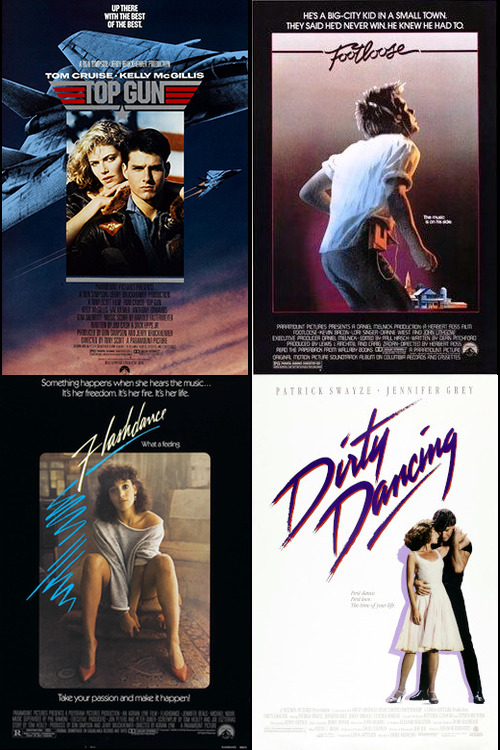
A selection of 1980s movie posters known for their soundtracks

The best 80s movie soundtracks include Top Gun, Footloose, Dirty Dancing, Flashdance, Purple Rain, Ghostbusters, and The Breakfast Club — albums where the songs became as famous as the films, several topping the charts and winning Oscars. The decade turned the soundtrack into an art form and a cash machine.

The chart-topping juggernauts

Some 80s soundtracks were phenomena in their own right. Flashdance (1983) kicked the era into gear with Irene Cara’s Oscar-winning “Flashdance… What a Feeling” and Michael Sembello’s “Maniac.” Footloose (1984) delivered a wall-to-wall hit parade, led by Kenny Loggins’s title track. And Top Gun (1986) may be the ultimate example — Loggins’s “Danger Zone” and Berlin’s Oscar-winning “Take My Breath Away” turned a fighter-jet movie into a permanent radio fixture.

Then there’s the crossover event of the decade: Purple Rain (1984). Prince’s soundtrack wasn’t just tied to a movie — it was a chart-dominating #1 album on its own, spawning “When Doves Cry,” “Let’s Go Crazy,” and the epic title track. Music and film became genuinely inseparable.

The songs that WERE the movie

Certain 80s films are now impossible to separate from a single song. Dirty Dancing (1987) climaxes with “(I’ve Had) The Time of My Life,” the Oscar-winning Bill Medley and Jennifer Warnes duet. Ghostbusters (1984) had Ray Parker Jr.’s inescapable theme, complete with its own call-and-response. And The Breakfast Club (1985) is forever bonded to Simple Minds’ “Don’t You (Forget About Me)” — one of many reasons John Hughes had the decade’s best musical instincts, as we cover in our John Hughes movies guide.

Even the fist-in-the-air anthems came from movies: Glenn Frey’s “The Heat Is On” from Beverly Hills Cop (1984), John Parr’s “St. Elmo’s Fire (Man in Motion)” (1985), and Huey Lewis and the News’s “The Power of Love” from Back to the Future (1985).

The maestros of the score

Not all of it was pop. The 80s were also a peak era for the orchestral film score. John Williams scored the decade’s biggest adventures — E.T., the Star Wars sequels, and the Indiana Jones films — creating themes as recognizable as any hit single. Vangelis won an Oscar for the shimmering synth score of Chariots of Fire (1981) and built the haunting soundscape of Blade Runner. And Harold Faltermeyer’s synth-driven “Axel F” from Beverly Hills Cop proved an instrumental could be a smash.

Remember when you bought the soundtrack cassette specifically so you could relive the movie in your Walkman — and half the songs turned out to be radio hits you already loved?

Why 80s soundtracks still hit

The 80s movie soundtrack endures because it was built for maximum emotional impact and maximum replay value. Studios and record labels worked hand in hand to make songs that could carry a film’s biggest moments and dominate the radio, and the best of them did both. Decades later, these tracks instantly summon their films — and their era — with a power few other art forms can match. In the 80s, the right song didn’t just accompany the movie. It became the memory.

FAQ

What is the best 80s movie soundtrack?
It’s fiercely debated, but Purple Rain (1984), Top Gun (1986), Dirty Dancing (1987), and Footloose (1984) are perennial picks — each producing multiple massive hits.

Which 80s movie songs won Oscars?
Best Original Song winners included “Flashdance… What a Feeling” (Flashdance), “Take My Breath Away” (Top Gun), and “(I’ve Had) The Time of My Life” (Dirty Dancing).

Why were 80s soundtracks so popular?
Studios and record labels deliberately paired films with radio-ready hit songs, so a movie could sell an album and a song could sell a movie — a synergy the era perfected.

Who was the king of 80s movie soundtracks?
Kenny Loggins earned the nickname for his string of soundtrack smashes, including “Footloose,” “Danger Zone” (Top Gun), and “I’m Alright” (Caddyshack).

What 80s film composers are most famous?
John Williams (E.T., Indiana Jones, Star Wars), Vangelis (Chariots of Fire, Blade Runner), and Harold Faltermeyer (Beverly Hills Cop) are among the era’s most celebrated.


These songs powered the decade’s coming-of-age classics — revisit them in our 80s teen movies roundup, or take the full John Hughes movies tour.

By 1989 the hair-metal party had been raging for years, and plenty of people figured the scene was running out of gas. Then a band of young unknowns from New Jersey kicked the door in with a snarling six-foot-plus blond frontman and a debut so ferocious it made the whole genre feel dangerous again. Skid Row didn’t just join the party — they gave it one last, glorious roar.

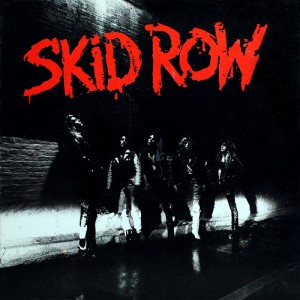
Skid Row – Skid Row (1989) album cover

Skid Row is the New Jersey hard-rock band whose 1989 self-titled debut, fronted by Sebastian Bach, closed out the decade with hits like “Youth Gone Wild,” “18 and Life,” and “I Remember You.” Heavier and hungrier than most of their peers, they were the last great band of the 80s glam-metal wave.

A debut that hit like a fist

Skid Row was released in January 1989 on Atlantic Records and went multi-platinum fast. It had everything: the rebel anthem (“Youth Gone Wild”), the tender ballad (“I Remember You”), and the dark, dramatic story-song that became their signature — “18 and Life.” That song, released in mid-1989, climbed to No. 4 on the Billboard Hot 100 and told the grim tale of an 18-year-old named Ricky, sentenced to life for killing another teen. It was heavier subject matter than the party anthems ruling the charts, and Bach sold every ounce of its drama.

The frontman who became a lightning rod

Sebastian Bach — born Sebastian Bierk in Canada — fronted Skid Row from 1987 to 1996 and became one of the most electric performers of the era. Tall, blond, wild, and blessed with a huge, screaming range, he was made for the MTV spotlight. He gave the band a charisma and a menace that set them apart from the sweeter glam acts, and he became the face of a group that felt like it had more edge than the hair-metal label suggested. Bach’s presence is a big reason the debut still sounds urgent decades later.

Remember when “I Remember You” came on and even the toughest kids in the room went quiet? Skid Row could snarl through “Youth Gone Wild” and then break your heart with a ballad in the same set — the range that made their debut such a knockout.

Why Skid Row endures

Skid Row arrived right at the edge of the cliff — within a couple of years, grunge would sweep the whole hair-metal scene away — which gives their debut a special place in the story. It’s the sound of the 80s going out swinging, harder and hungrier than it started. Their first two albums remain fan favorites, Bach went on to a busy solo and acting career, and “18 and Life” and “I Remember You” are permanent fixtures on any 80s rock playlist. The last great gasp turned out to be one of the best.

What came next

Skid Row’s story has a remarkable second chapter that proves they were more than a glam act. Their 1991 follow-up, Slave to the Grind, was heavier, angrier, and more aggressive than the debut — and it became one of the first genuinely heavy albums to debut at No. 1 on the Billboard chart. That was a statement: as grunge was gathering to sweep away the hair-metal scene, Skid Row was already pushing toward something tougher and more serious. Sebastian Bach’s ferocious vocals and the band’s harder edge gave them credibility that a lot of their sweeter peers lacked. It didn’t save the genre from the coming shift, but it did mark Skid Row as the band that saw the wall coming and tried to punch through it rather than get buried.

FAQ

Who was the lead singer of Skid Row?
Sebastian Bach fronted the band from 1987 to 1996, becoming one of the era’s most charismatic performers.

What is Skid Row’s biggest hit?
“18 and Life,” which reached No. 4 on the Billboard Hot 100 in 1989, alongside “I Remember You” and “Youth Gone Wild.”

When did Skid Row’s debut album come out?
January 1989 — one of the last major glam-metal breakthroughs before grunge changed the landscape.

What is “18 and Life” about?
It tells the story of an 18-year-old named Ricky sentenced to life in prison for killing another teenager.


Skid Row closed the decade strong — see the whole scene in our best 80s hair bands guide, or grab a slice with Warrant next.

Some kids in the 80s dreamed about being on TV. Bobby Catalano actually was — five days a week, dancing in front of a cable audience that stretched across the entire tri-state area. If you grew up watching Dance Party USA, you didn’t need a last name. He was just Bobby.

Bobby Catalano, co-host of the Awesome 80s Podcast and Dance Party USA alumnus

Bobby Catalano was a regular on Dance Party USA — first on the air in 1985 — who went on to host the show from 1989 to 1991, and today he co-hosts Bobby and Jason’s Awesome 80s Podcast — the same 80s-obsessed energy, now pointed at the whole decade instead of one dance floor. He came up through the studio the way the best regulars did: as one of the kids on the floor first, and behind the microphone second.

From the dance floor to the host chair

Dance Party USA ran on the USA Network from 1986 to 1992, filmed in Philadelphia with production offices in Camden, New Jersey — squarely in Bobby’s tri-state backyard. Bobby was first on the air in 1985, coming up through Philadelphia’s Dancin’ On Air before Dance Party USA went national — a regular, one of the core on-camera kids fans tuned in specifically to watch. Then, from 1989 to 1991, he moved up to hosting duties alongside co-host Heather “Princess” Day.

That’s a real arc: kid on the floor to host of the show. It’s the kind of thing that only happened to the regulars who had genuine on-camera presence, and it made Bobby one of the faces of the show during its peak years.

The lip-sync legend

The show’s format leaned hard on lip-sync performances, and Bobby’s are the ones fans still bring up decades later — the spotlight numbers where a regular got the floor to themselves and sold a hit song to the camera. Ask longtime viewers and you’ll hear about specific performances, sunglasses-and-all, that stuck in their memory the way only 80s TV can. That’s the mark of a real regular: people didn’t just watch the show, they watched him.

The phenomenon he was part of

It’s worth remembering just how big Dance Party USA was in its corner of the world. It aired daily on the USA Network for six years, built on freestyle music and a floor of real teenagers rather than professional performers — and in the Philadelphia and tri-state area, its regulars were genuine local celebrities, recognized in public and followed by fans. Being one of the show’s hosts during its peak meant Bobby was one of the faces a whole region tuned in to see, five days a week. That’s the foundation everything he does now is built on: not a fan looking back at the 80s, but someone who was actually on camera in the middle of them.

Bobby Catalano now

These days Bobby channels all of that 80s energy into Bobby and Jason’s Awesome 80s Podcast and this site, bobbyandjason.com, alongside his longtime friend and co-conspirator Jason Pascoe — who was right there on Dance Party USA with him. He’s the resident superfan who’s proudly, permanently stuck in the best parts of the decade.

The through-line is simple: the kid who danced his way onto tri-state TV never actually left the 80s. He just found a bigger stage to celebrate it from. (For a pure show-era angle on the shades and the lightning lip-syncs, WatchParty USA keeps a Bobby profile in its Dance Party USA archive.)

FAQ

Who is Bobby Catalano?
Bobby Catalano is a former Dance Party USA regular and host who now co-hosts Bobby and Jason’s Awesome 80s Podcast and runs bobbyandjason.com.

When was Bobby Catalano on Dance Party USA?
He was first on the air in 1985, became one of the show’s regulars, and served as one of its hosts from 1989 to 1991.

What is Bobby Catalano doing now?
He co-hosts an 80s nostalgia podcast with Jason Pascoe, celebrating the music, movies, TV, and pop culture of the decade.

Did Bobby Catalano host Dance Party USA?
Yes — after coming up as a dancer, he hosted from 1989 to 1991, alongside co-host Heather “Princess” Day.

Where is Bobby Catalano from?
He’s a tri-state-area guy — Dance Party USA was a Philadelphia–South Jersey production, and its biggest audience was right there in the region he called home.


Bobby’s story is one half of the act — meet his co-conspirator in our Jason Pascoe on Dance Party USA profile, or go back to the beginning with what Dance Party USA was.

Winger arrived at the tail end of the 80s with all the hallmarks — the hair, the hooks, the ballads, the MTV polish — and rode them to platinum success. Then they became an unlikely punchline. And then, in the most surprising twist of any hair-metal story, their frontman quietly reinvented himself as a serious classical composer. Stick with this one; it goes somewhere you won’t expect.

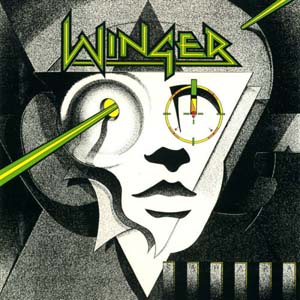
Winger – Winger (1988) album cover

Winger is the American glam-metal band, led by singer-bassist Kip Winger, whose 1988 self-titled debut went platinum on the strength of hits like “Seventeen” and “Headed for a Heartbreak.” They were among the last big breakouts of the hair-metal era — and their leader had far more range than the label suggested.

The hits that made them stars

Winger’s debut landed in August 1988 on Atlantic Records and quickly went platinum. “Seventeen” became their signature single, reaching No. 26 on the Billboard Hot 100, with a video that stayed in heavy MTV rotation. “Headed for a Heartbreak” followed as a successful power ballad. Kip Winger — polished, trained, and technically accomplished — brought a musicianship to the band that stood out even as the hooks stayed radio-friendly. For a moment, they were one of the hottest new acts in rock.

From punchline to composer

Here’s the arc almost nobody sees coming. As grunge swept in and hair metal fell out of fashion, Winger became an easy target — the band’s name was even used as shorthand for everything uncool about the era (famously worn as a mocking t-shirt on an animated MTV show). It was a rough fall.

But Kip Winger had the last laugh in the most unexpected way. A classically trained musician, he pivoted to composing serious orchestral and classical music — earning genuine critical acclaim, commissions, and even award recognition in the classical world. The guy the 90s wrote off as the ultimate hair-metal lightweight turned out to be one of the most legitimately accomplished musicians to come out of the whole scene. It’s the perfect rebuke to anyone who assumed the genre was all fluff.

Remember when a band’s name became a national punchline — and it turned out the joke was on the people making it? Kip Winger’s second act as a respected composer is one of the great “don’t judge a book by its cover” stories in 80s music.

Why Winger endures

Winger’s story is a two-parter that’s better than either half alone: a genuine platinum-selling hair-metal act, and a frontman whose talent outran the trend that made him famous. The 80s hits still hold up on any glam-metal playlist, and Kip’s classical career gives the band a legacy no one predicted. Underestimate the guy with the big hair at your own risk.

Real players behind the polish

Lost in the mockery Winger took in the 90s is a simple fact: they were genuinely skilled musicians. Guitarist Reb Beach was a technical standout — his riff for “Seventeen” reportedly came from something he’d written at just 15 — and went on to a respected career with other major rock acts. Kip Winger himself had trained as a musician and even toured with Alice Cooper before forming the band. That depth is why the group’s reunion albums in later years earned real critical praise, and why Kip’s move into serious classical composition made sense to anyone who’d actually listened closely. The “Winger” name became lazy shorthand for hair-metal excess, but the joke never accounted for the talent in the room. Sometimes the most underrated bands are the ones a trend decided to make an example of.

FAQ

What are Winger’s biggest hits?
“Seventeen” and “Headed for a Heartbreak,” both from their platinum 1988 debut album.

Who is the frontman of Winger?
Kip Winger, the band’s singer and bassist, a classically trained musician.

What did Kip Winger do after the hair-metal era?
He became an acclaimed classical and orchestral composer, earning serious recognition far outside the rock world.

When did Winger break out?
With their self-titled debut in 1988, one of the last major hair-metal breakthroughs before grunge.

Who is the guitarist in Winger?
Reb Beach, a highly regarded technical guitarist who wrote the riff to “Seventeen” and later played with other major rock acts, including Whitesnake.


Winger had a surprising second act — meet more of the scene in our best 80s hair bands guide, or head to White Lion next.

Two families lined up across a bright, spinning-topped set, a host reading a survey question, and everybody at home shouting a guess at the screen a half-second before the buzzer. “We surveyed 100 people…” In the 80s, Family Feud took the simplest premise imaginable — guess what other people said — and turned it into daytime gold.

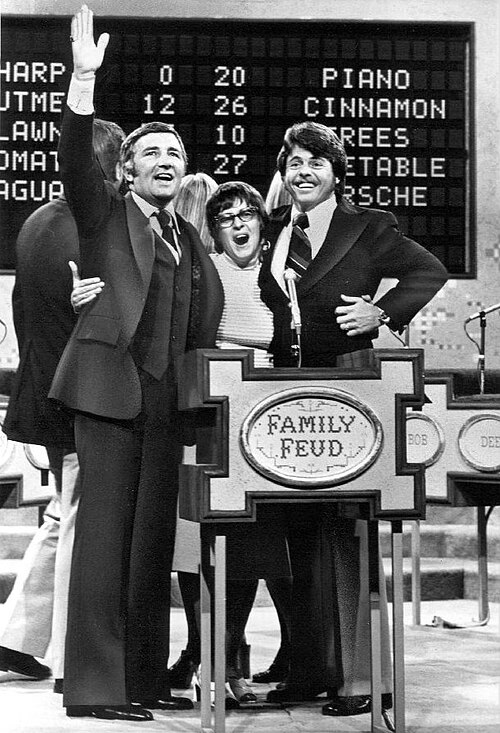
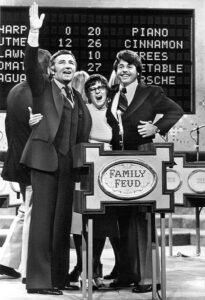
Richard Dawson hosting Family Feud

Family Feud pits two families against each other to guess the most popular answers to survey questions posed to 100 people. In the 80s it was defined by host Richard Dawson, whose showmanship — and famous habit of kissing contestants — made him a daytime star, before a hit 1988 revival brought on host Ray Combs. It was one of the most quotable game shows of the decade.

“Survey says!” and the perfect format

The beauty of Family Feud is that anyone can play it. There’s no trivia to know — just a feel for what regular people would say. Name a reason you’d call in sick. Name something you find in a purse. Contestants guessed, the board revealed the survey’s top answers with that satisfying ding, and the host’s “Survey says!” turned every reveal into a little drama. Two wrong answers from a stealing family and the round flipped. It was social intuition as a game, and families at home played right along, arguing over every answer.

Richard Dawson, the kissing host

For most of the 80s, Family Feud was Richard Dawson’s show. The British-born host — already famous from Hogan’s Heroes — brought a lounge-singer charm, a quick wit, and one very memorable habit: he kissed nearly every female contestant, often on the lips, as a good-luck greeting. It was his trademark, controversial even then, and utterly inseparable from his era of the show. His warmth with contestants and his command of the studio made him one of the definitive game show hosts of the decade.

Remember when a contestant would blurt out a wild, obviously-wrong answer, the host would repeat it deadpan to the studio, and everyone held their breath waiting for the board — before that big red X and the buzzer dropped and the whole family groaned? Those gloriously bad answers were half the reason to watch.

The reboot and Ray Combs

Dawson’s original run ended in 1985, but the format was too good to stay gone. In 1988, Family Feud came roaring back with a new host, Ray Combs, whose energetic, comedic style won over a fresh audience and kept the show a fixture into the 90s. (Dawson would even return briefly.) The late-80s revival proved the Feud engine could outlive any single host — a lesson the show has demonstrated many times since.

Why Family Feud still surveys

Family Feud turned out to be one of the most resilient formats in television, revived again and again with new hosts for new generations. But the 80s gave it its identity: the survey board, the two-family showdown, “Survey says!”, and Richard Dawson’s charm (and kisses). Every version since is playing the game those years perfected.

FAQ

How does Family Feud work?
Two families compete to guess the most popular answers to questions asked of a 100-person survey, racking up points and stealing rounds from each other.

Who hosted Family Feud in the 80s?
Richard Dawson hosted through 1985, and the show was revived in 1988 with host Ray Combs.

Why was Richard Dawson famous on the show?
For his charm and quick wit — and for his trademark habit of kissing female contestants as a greeting, which became inseparable from his era.

What’s the show’s catchphrase?
“Survey says!” — the host’s cue as the board revealed whether a guess made the survey’s top answers.

When was Family Feud revived?
In 1988, with Ray Combs as host, after Dawson’s original run ended in 1985.

Do you need trivia knowledge to play?
No — the game rewards guessing what ordinary people would say, not knowing facts, which is a big part of its wide appeal.


Family Feud was one of the most quotable great 80s game shows — see the whole lineup there, or come on down to The Price Is Right next.

Scroll to top